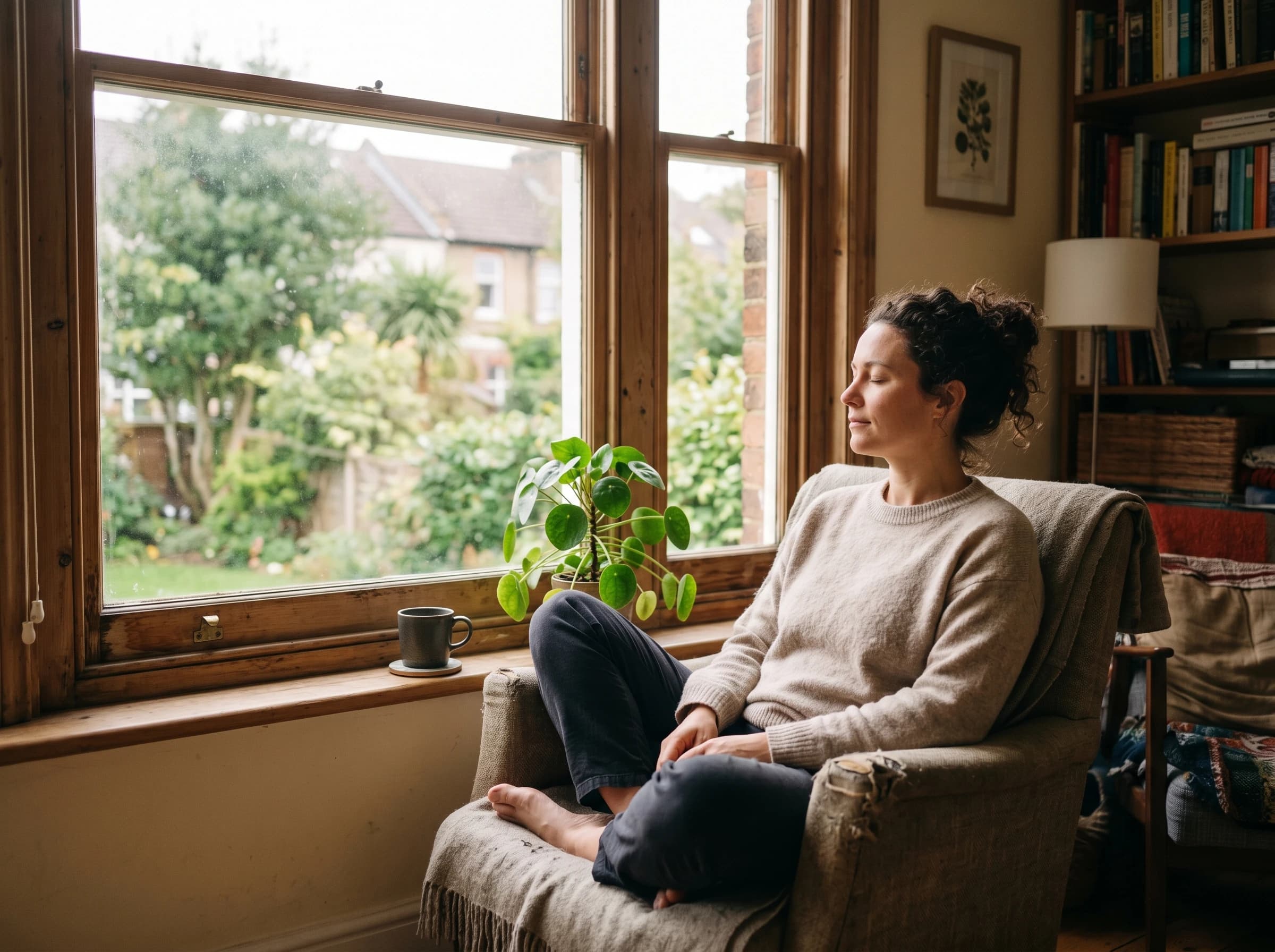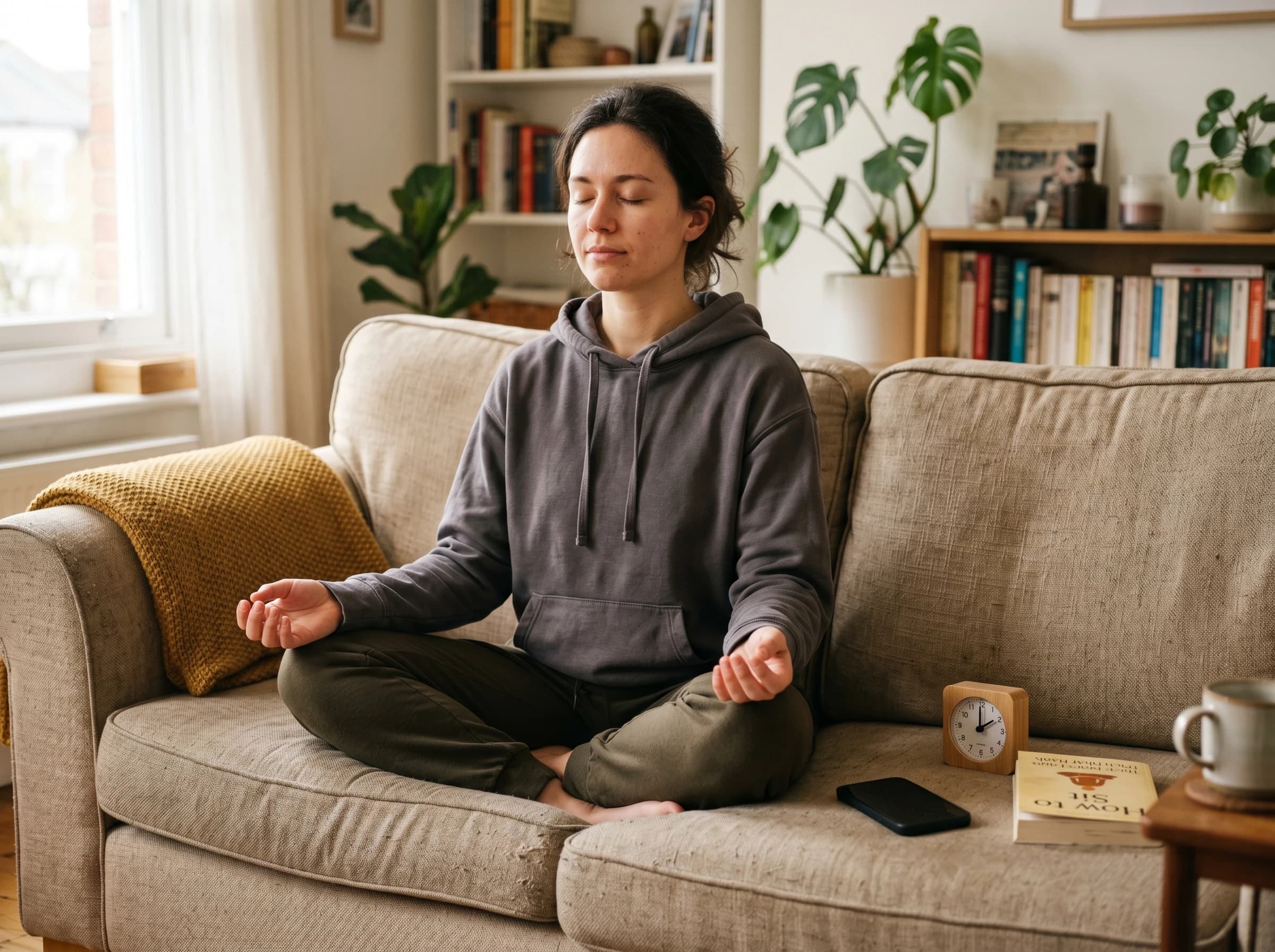

Mindful living means bringing deliberate, non-judgmental attention to your everyday experience. That is not just on a meditation cushion, but in how you eat, work, listen, and rest. It is a trainable skill with real research behind it, not an aesthetic or a state of permanent calm. This guide covers what it actually is, what the evidence supports and doesn't, how to start small, and when it isn't the right tool.
Key takeaways
- Mindful living is deliberate, non-judgmental attention to everyday experience — a trainable skill, not an aesthetic or a personality type.
- The best evidence shows small-to-moderate improvements in anxiety, depression, and stress — real, but not a cure-all.
- A realistic start: five minutes of mindful breathing a day for two weeks, plus one daily activity done with full attention.
- It is not a substitute for professional help when mood, anxiety, or sleep feel unmanageable.
What mindful living actually means (and what it isn't)
Mindful living is the practice of paying attention, on purpose, to the present moment, without immediately judging or reacting to it. The idea traces back to the Pali word sati (awareness, attention, remembering). It entered modern healthcare through Jon Kabat-Zinn. In the late 1970s, he built Mindfulness-Based Stress Reduction (MBSR) into a secular clinical program at the University of Massachusetts (Kabat-Zinn, 1982).
It helps to be clear about what mindful living is not. It is not a permanently calm mood, an empty mind, or the serene aesthetic that fills social media. You can be fully mindful while washing dishes, sitting in traffic, or feeling anxious. The aim is clarity and presence, not peace at all costs.
How it differs from meditation
Meditation is one tool for training mindfulness. Mindful living is applying that same quality of attention across the day. Meditation is the training ground; mindful living is the field where the skill gets used. You can practice mindful living without ever sitting formally, though regular practice tends to deepen it.
What the research actually shows
Mindfulness has genuine evidence behind it, and it is also widely oversold, so it is worth being precise.
The most-cited evaluation is a 2014 meta-analysis in JAMA Internal Medicine. It found that mindfulness programs produced small-to-moderate improvements in anxiety, depression, and pain, with effect sizes around 0.3 at eight weeks. Importantly, it found no evidence that they outperform other active treatments such as exercise or medication (Goyal et al., 2014). A large umbrella review pooling 44 meta-analyses (336 trials and more than 30,000 participants) reached a similar verdict (Goldberg et al.). Mindfulness-based programs clearly beat doing nothing across many conditions, with effects ranging from very small to large. But head-to-head, they were only about as good as other established therapies.
There is also evidence for the "living" part, not just formal sessions. A widely cited 2003 study looked at everyday mindfulness rather than formal practice. People who are naturally more mindful reported better mood, lower stress, and more self-directed behavior, whether or not they meditate (Brown & Ryan, 2003). The honest summary: mindfulness is a useful, evidence-based skill for stress and mood, roughly on par with other good tools. The evidence is weaker and shorter-lived for many of the bigger claims made about it (NCCIH).
How to start (small and realistic)
You do not need a 30-day challenge or a 45-minute daily sit. Most of the benefit comes from short, consistent practice plus bringing attention to things you already do.
- Mindful breathing (1–2 minutes): Rest your attention on the feeling of breathing. When your mind wanders, and it will, notice that and return. The returning is the practice.
- Single-tasking: Pick one activity (a meal, a walk, a phone call) and give it your whole attention. Notice what changes when you are not also doing something else.
- Mindful transitions: Use natural breaks, like ending a call or leaving a room, to take one breath and reset before the next thing.
- Body scan (5–10 minutes): Move your attention slowly from head to feet, noticing sensations without trying to change them.
A realistic start is five minutes of mindful breathing a day for two weeks, plus one daily activity done mindfully. For more options grounded in evidence, see mindful habits backed by research, and for the stress angle, breathwork for stress.
Common misconceptions
"It means having a clear mind." No. Mindfulness is noticing when your mind has wandered and gently returning. The wandering is expected and is not a failure.
"I have to meditate every day." Daily practice builds the skill faster, but informal mindfulness during ordinary activities has real value on its own.
"It's religious." Mindfulness has roots in Buddhist practice, but the clinical version studied in research is secular and has been used in hospitals, schools, and workplaces without religious content.
When mindful living isn't enough, and when it can backfire
This is the part most guides skip. Mindfulness is a support, not a standalone treatment for serious conditions. If you are dealing with depression, an anxiety disorder, or trauma, mindfulness can complement professional care. It should not replace it.
It can also have downsides. The NCCIH notes that about 8 percent of people in studies reported a negative effect, most often increased anxiety or low mood (NCCIH). Research led by Willoughby Britton found that a majority of participants experienced at least one unpleasant meditation-related effect. Roughly 6 percent reported effects that interfered with daily life for more than a month (Britton et al.). People with trauma histories can find intensive silent practice destabilizing, so going slowly and seeking trauma-informed guidance matters.
None of this makes mindfulness dangerous for most people. It means it is a real intervention with real effects, worth approaching with the same realism you would bring to anything else. If your mood, anxiety, or sleep feel unmanageable, that is a reason to talk to a professional. Our guide to mindfulness and emotional well-being goes deeper on the emotional side, and conscious living for mental clarity covers the focus and attention angle.
Mindful living is a starting point, not a destination. You can explore the rest of our mindful living guides to go further. And if you want a lighter companion for the journey, our collection of inspiring mindful living quotes is an easy place to return to.
Frequently Asked Questions (FAQ)
Is mindful living the same as meditation? No. Meditation is one way to train mindfulness. Mindful living is carrying that attention into ordinary activities, with or without a formal sit.
Do I have to meditate every day? No. Daily practice helps build the skill faster, but informal mindfulness during things you already do counts and has its own value.
Is mindfulness religious? It has roots in Buddhist contemplative traditions, but the clinical forms used in research are secular and include no religious content.
Can mindfulness be harmful? For most people any discomfort is mild and passing, but a minority experience effects that linger. People with trauma histories in particular should start gently and consider trauma-informed teachers or therapists.
How long until it helps? Many people notice small shifts within a couple of weeks of consistent practice. The research-backed effects are real but modest, so think steady habit rather than quick fix.
Medical disclaimer: This article is for informational purposes only. Always consult a qualified healthcare provider before making changes to your health routine.
Sources
- Kabat-Zinn J. An outpatient program in behavioral medicine for chronic pain patients based on the practice of mindfulness meditation. General Hospital Psychiatry, 1982 — PubMed. https://pubmed.ncbi.nlm.nih.gov/7042457/
- Goyal M, et al. Meditation programs for psychological stress and well-being: a systematic review and meta-analysis. JAMA Internal Medicine, 2014 — PubMed. https://pubmed.ncbi.nlm.nih.gov/24395196/
- Goldberg SB, et al. The empirical status of mindfulness-based interventions: a systematic review of 44 meta-analyses of randomized controlled trials — PubMed Central. https://pmc.ncbi.nlm.nih.gov/articles/PMC8364929/
- Brown KW, Ryan RM. The benefits of being present: mindfulness and its role in psychological well-being. Journal of Personality and Social Psychology, 2003 — PubMed. https://pubmed.ncbi.nlm.nih.gov/12703651/
- Meditation and Mindfulness: What You Need To Know — National Center for Complementary and Integrative Health (NCCIH). https://www.nccih.nih.gov/health/meditation-and-mindfulness-what-you-need-to-know
- Britton WB, et al. Defining and measuring meditation-related adverse effects in mindfulness-based programs — PubMed Central. https://pmc.ncbi.nlm.nih.gov/articles/PMC8845498/
All sources accessed 24 May 2026.

Sophia Martinez
A wellness writer at The Wellness Voyage, focused on what the evidence actually says about mindfulness and everyday wellbeing practices.