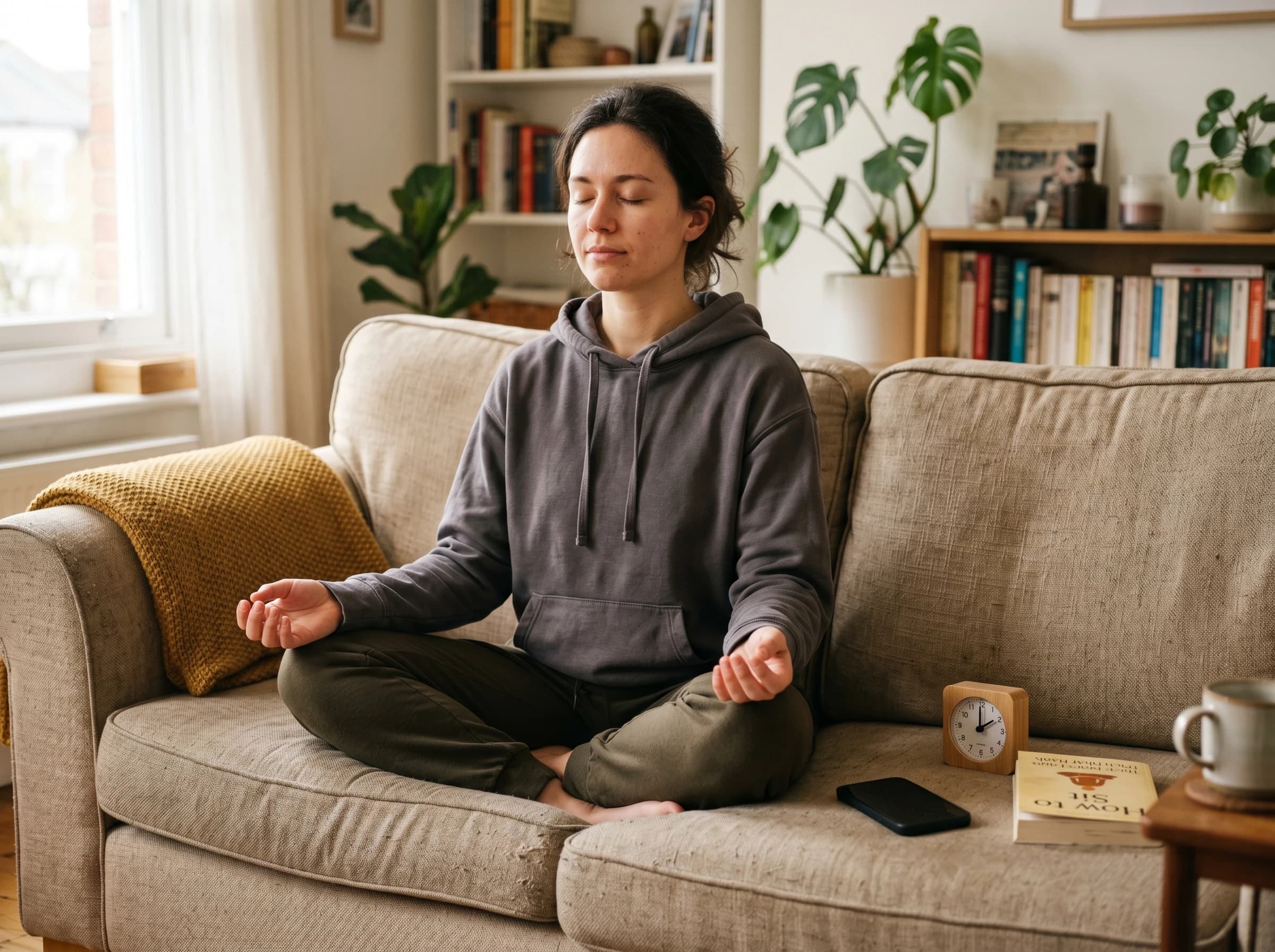

Plenty of "mindful habits" get recommended online, but they do not all have the same evidence behind them. This guide goes practice by practice, with honest effect sizes, so you can spend your time on the ones that actually hold up. It ends with what the research says about making a habit stick.
The honest big picture
Mindfulness is one of the better-studied wellness practices, tested in hundreds of randomized trials. A 2014 meta-analysis in JAMA Internal Medicine found small-to-moderate improvements in anxiety, depression, and pain, with no sign that mindfulness beats other active treatments like exercise or therapy (Goyal et al., 2014). A large umbrella review of 44 meta-analyses (336 trials and more than 30,000 people) reached the same verdict: clearly better than doing nothing, and about as good as other established options (Goldberg et al.). The NCCIH adds that meditation is now the most-used complementary health approach in the US, mainly for stress, sleep, and general wellness (NCCIH).
So the honest frame is "useful, not magic." If the whole idea is new to you, start with what mindful living actually is. With that context, here is how the specific habits stack up.
The practices, by strength of evidence
Formal meditation (breath focus and body scan)
This is the most-studied habit, and it anchors the evidence above. A short daily sit, focusing on the breath or moving attention slowly through the body in a body scan, is what most of those trials actually tested. You do not need long sessions. Even 10 to 15 minutes a day, done consistently, reflects how the research was designed (NCCIH).
Breathwork
Deliberate breathing is a strong, practical option. In a 2023 randomized trial, five minutes a day of structured breathing for a month improved mood and lowered physiological arousal. The exhale-focused "cyclic sighing" pattern slightly outperformed mindfulness meditation on mood (Balban et al., 2023). We cover the techniques in detail in breathwork for stress.
Mindful eating
Mindful eating helps most with how you eat. A 2024 meta-analysis found it improved attention to fullness, reduced external-cue eating, and lowered sweet intake, but its effects on emotional eating and binge eating were small and not statistically significant (mindful eating meta-analysis). It is a useful attention practice, not a reliable weight-loss tool.
Gratitude journaling
Gratitude practices have real but modest effects. A 2023 meta-analysis of dozens of trials found small reductions in depression and anxiety symptoms, on the order of 7 to 8 percent versus controls, and the authors were candid that the effect is small next to treatments like medication (gratitude meta-analysis). Think of it as a low-cost complement, not a stand-alone fix.
Mindfulness for sleep
If sleep is your target, there is direct evidence. In a randomized trial in older adults with sleep problems, a mindfulness program improved sleep quality more than standard sleep-hygiene education (Black et al., 2015). A short wind-down practice is a reasonable habit to build. For the bigger picture, see recovering from sleep debt, and for the mood side of practice, mindfulness and emotional well-being.
Walking meditation and the rest
Some popular practices, like walking meditation, are pleasant but far less studied. The honest answer is that the evidence is limited and preliminary. They are fine to try; just hold the claims loosely.
How to actually build a mindful habit
Picking a good practice is half the work. Making it stick is the other half, and the popular "21 days" figure is a myth. In a real-world study summarized by Gardner, Lally, and Wardle, automaticity, the sense that a behavior happens on its own, plateaued after about 66 days on average, with a wide range across people and behaviors (Gardner et al.). Two details make this encouraging: simpler actions become automatic faster, and missing the occasional day does not derail the process.
The practical takeaways:
- Anchor it to something you already do. Attach two minutes of breathing to your morning coffee or your commute.
- Start smaller than feels necessary. Five minutes you repeat beats twenty minutes you skip.
- Plan for about ten weeks, not three. Expect it to feel effortful at first and easier over time.
- Treat a missed day as normal. Returning the next day is the skill, not a reset to zero.
Frequently Asked Questions (FAQ)
Which mindful habit has the strongest evidence? Formal meditation has the deepest research base, and breathwork is a strong, practical runner-up. Both show small-to-moderate effects on stress and mood.
How long until a habit sticks? On average around 66 days, but it varies widely from person to person. Plan for roughly ten weeks rather than the popular but inaccurate 21 days.
Do I need to meditate for a long time? No. A consistent 10 to 15 minutes a day reflects how most studies were run, and short daily practice beats long, occasional sessions.
Is gratitude journaling actually worth it? The effects are small but real, and it costs almost nothing. Treat it as a complement to other habits rather than a treatment on its own.
Medical disclaimer: This article is for informational purposes only. Always consult a qualified healthcare provider before making changes to your health routine.
Sources
- Goyal M, et al. Meditation programs for psychological stress and well-being: a systematic review and meta-analysis. JAMA Internal Medicine, 2014 — PubMed. https://pubmed.ncbi.nlm.nih.gov/24395196/
- Goldberg SB, et al. The empirical status of mindfulness-based interventions: a systematic review of 44 meta-analyses of randomized controlled trials — PubMed Central. https://pmc.ncbi.nlm.nih.gov/articles/PMC8364929/
- Meditation and Mindfulness: What You Need To Know — National Center for Complementary and Integrative Health (NCCIH). https://www.nccih.nih.gov/health/meditation-and-mindfulness-what-you-need-to-know
- Diniz G, et al. The effects of gratitude interventions: a systematic review and meta-analysis. Einstein (São Paulo), 2023 — PubMed Central. https://pmc.ncbi.nlm.nih.gov/articles/PMC10393216/
- Gardner B, Lally P, Wardle J. Making health habitual: the psychology of 'habit-formation' and general practice. British Journal of General Practice, 2012 — PubMed Central. https://pmc.ncbi.nlm.nih.gov/articles/PMC3505409/
- Balban MY, et al. Brief structured respiration practices enhance mood and reduce physiological arousal. Cell Reports Medicine, 2023 — PubMed Central. https://pmc.ncbi.nlm.nih.gov/articles/PMC9873947/
- Black DS, et al. Mindfulness meditation and improvement in sleep quality and daytime impairment among older adults with sleep disturbances. JAMA Internal Medicine, 2015 — PubMed. https://pubmed.ncbi.nlm.nih.gov/25686304/
- Effects of mindfulness-based interventions on obesogenic eating behaviors: a systematic review and meta-analysis. Obesity Reviews, 2024 — PubMed. https://pubmed.ncbi.nlm.nih.gov/39489689/
All sources accessed 24 May 2026.

Sophia Martinez
A wellness writer at The Wellness Voyage, focused on what the evidence actually says about mindfulness and everyday wellbeing practices.