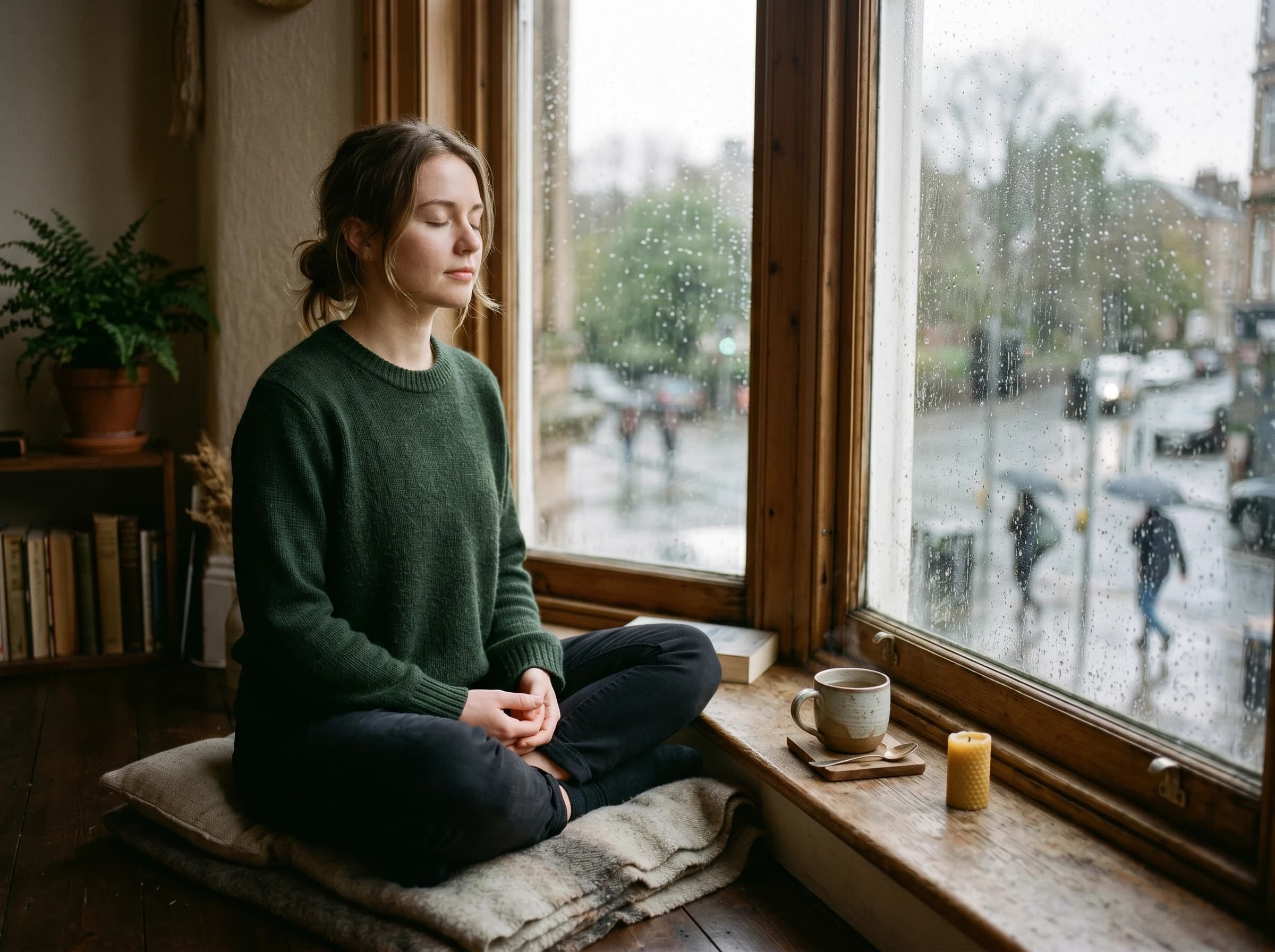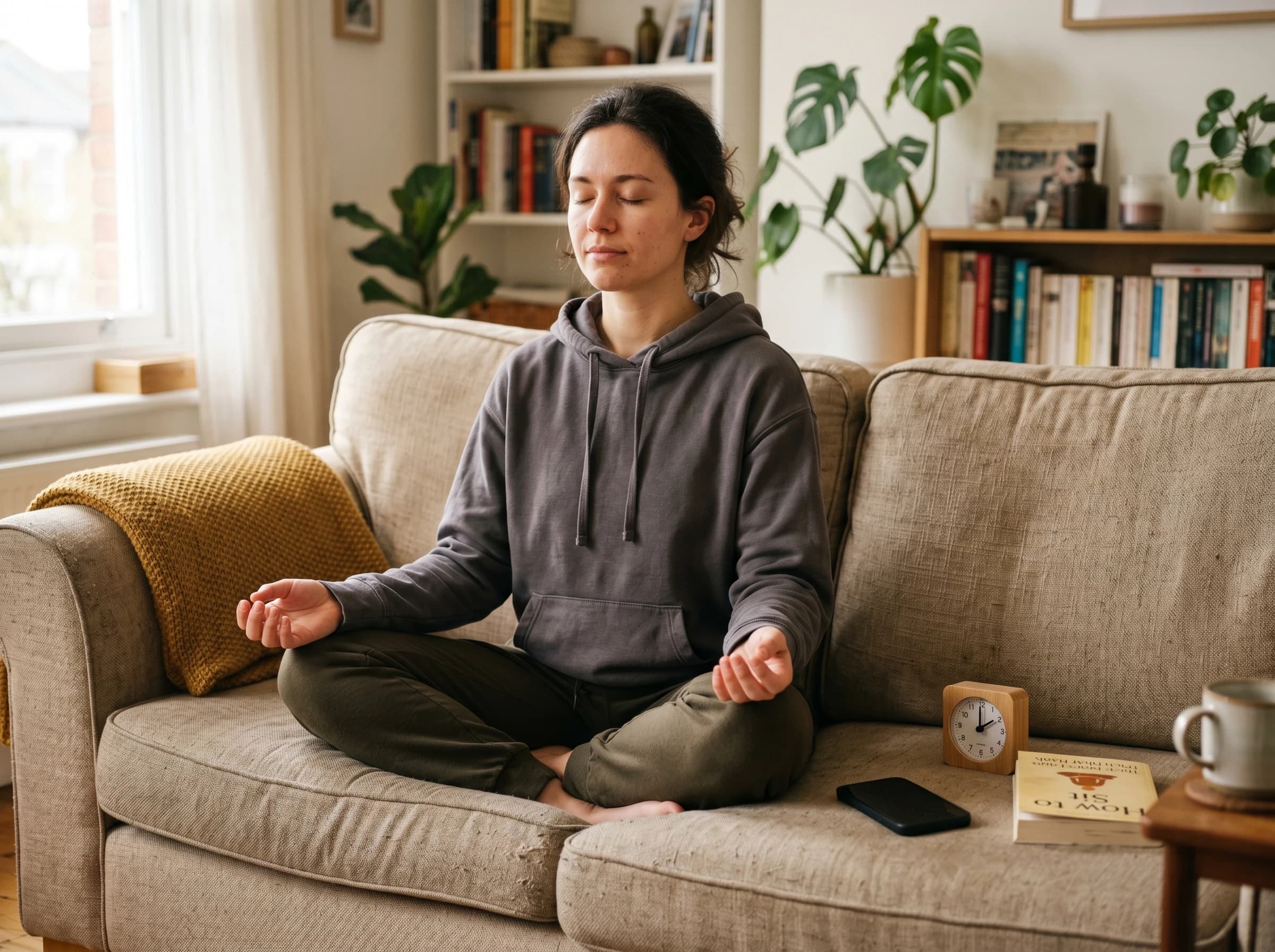

Quick answer: Start with five minutes: a phone-free minute, two minutes of breathing, and two minutes of full attention on something you already do each morning, like making coffee. Anchor it to an existing habit rather than adding a new one, expect it to take a few weeks to feel automatic, and only grow it once the five-minute version is solid. It's a small, evidence-backed habit — not a cure for a bad day, but a genuine head start on it.
Most morning routines you see online are fantasies with good lighting: wake at five, meditate for thirty minutes, journal three pages, cold plunge, green smoothie. For anyone with a job, children, or a normal relationship with sleep, that's not a routine — it's a setup for guilt. A morning mindfulness routine that survives contact with real life looks nothing like that. It's small, it leans on things you already do, and it can be done in five minutes without setting your alarm any earlier.
This guide gives you a realistic starter routine, the science-backed reason it works, and a way to grow it only if you want to.
Why the morning is worth claiming
The first few minutes after waking set a tone that's hard to reset later. For most of us, that tone is now dictated by a phone: before we're fully conscious, we've absorbed news, messages, and other people's urgency, and the day starts in reaction mode. A brief mindful start does the opposite — it gives you a moment of your own attention before the world claims it.
There's a deeper reason too. Our minds wander for roughly half our waking hours, and that wandering tends to pull mood down (Killingsworth & Gilbert, 2010, Science). Starting the day by deliberately landing in the present is a small act of resistance against autopilot — and a rehearsal for catching yourself during the day.
What the evidence supports — and what it doesn't
Mindfulness has real, if modest, research support. A 2014 meta-analysis in JAMA Internal Medicine pooled 47 trials and found that meditation programmes produced small-to-moderate reductions in anxiety and depression symptoms — real effects, but not a cure, and not shown to outperform other active treatments (Goyal et al., 2014). The U.S. National Center for Complementary and Integrative Health reaches a similarly balanced verdict: mindfulness can help with anxiety, depression, and sleep, but it isn't a universal or complete solution (NCCIH).
Because this guide is specifically about morning practice, one more recent trial is worth naming directly. A 2024 randomised controlled trial recruited 1,247 adults across 91 countries and had them either follow a brief mindfulness app or listen to an audiobook for ten minutes a day over a month. The mindfulness group reported almost 20% fewer depression symptoms than the audiobook group, along with lower anxiety and a more positive outlook (Remskar et al., 2024, British Journal of Health Psychology; reported by Harvard Health). It isn't proof that morning timing specifically matters — the trial didn't compare morning practice against other times of day — but it does show that a short daily practice, kept up consistently for a month, produced a measurable effect.
None of this makes a five-minute morning habit a treatment for a diagnosed condition. Treat it as a low-cost, evidence-backed addition to your day, not a substitute for care — our guide to meditation for anxiety and overthinking goes further if what you're dealing with is more than everyday stress.
The five-minute morning routine
Here's a complete routine you can do before you've even left the bedroom. The order matters less than the consistency.
- One minute before the phone. Before you reach for your device, sit on the edge of the bed and take a few slow breaths. Notice you're awake, that it's a new day, and that — for this minute — nothing is being demanded of you.
- Two minutes of breathing or meditation. Follow your breath, or use a simple coherent-breathing pace of roughly five seconds in, five seconds out. When your mind wanders to the day ahead, gently return. Our breathing exercises for stress guide has more options if you want them.
- Two minutes of mindful routine. Pick one thing you already do — making coffee, showering, feeding a pet — and do it with full attention. Feel the warmth of the mug, smell the coffee, notice the water. No podcast, no scrolling. Just the task.
That's the whole thing. It asks for no extra time, only a different quality of attention to minutes you were going to spend anyway.
Why it works: ride an existing habit
The reason most morning routines fail isn't laziness — it's that they rely on willpower and memory, both of which are scarce at 7 a.m. The fix is to anchor your new practice to an existing one. Research on how habits form found that automaticity builds through consistent repetition in a stable context, taking a median of about 66 days to feel automatic — with an actual range across participants of 18 to 254 days (Lally et al., 2010).
The practical takeaways from that finding are clear:
- Attach, don't add. This is what behaviour-change researchers call habit stacking — or, in BJ Fogg's Tiny Habits framework, anchoring: tie mindfulness to a cue that already happens every morning — the kettle, the shower, the first coffee — so you don't have to remember it. James Clear's guide to habit stacking walks through the same idea in more depth if you want to apply it elsewhere in your day.
- Expect it to take a while. "Automatic" can take a couple of months. The early effortful phase is normal, not a sign it isn't working.
- Protect the context. Doing it in the same place, at the same point in your morning, makes the habit form faster.
How to scale it up (only if you want to)
Five minutes is a complete routine; plenty of people never need more. But if it starts to feel natural and you'd like to expand, grow it gradually:
- Lengthen the meditation from two minutes to five or ten before adding anything new.
- Add a one-line intention — a single sentence about how you want to show up today. Keep it concrete, not aspirational.
- Add a short walk and treat it as walking meditation: feel your feet, notice the air, let the to-do list wait.
| Element | Five-minute core | If you want more |
|---|---|---|
| Before the phone | One minute of slow breathing | — |
| Breathing or meditation | Two minutes | Five to ten minutes |
| Mindful task | Two minutes of full attention on one routine task | Add a short walk as walking meditation |
| Intention | Not included | One concrete, one-line intention for the day |
Add one element at a time, and only once the previous version is automatic. A bloated routine you skip is worse than a tiny one you keep.
Common mistakes
- Making it too big. The single most common reason morning routines collapse. Start smaller than feels meaningful.
- Checking the phone first. Once the inbox is open, the calm window has closed. The phone-free minute is the keystone.
- Demanding the perfect morning. Some mornings are chaos. A single mindful breath on a hard day still counts; don't make it all-or-nothing.
- Copying someone else's routine. A parent of toddlers and a night-shift worker need different mornings. Build yours around your real life.
When mornings just aren't possible
If your mornings are genuinely non-negotiable — early shifts, small children, a partner's schedule — don't force it. Mindfulness isn't time-of-day specific. A mindful commute, a midday five-senses pause, or an evening wind-down works just as well. The aim is a reliable daily anchor, and the best time is simply the one you'll actually keep. If evenings suit you better, our guide to slow living in the digital age offers a wider frame for protecting calm across the whole day.
When to be cautious
Mindfulness is safe for most people, but it isn't universally gentle. The NCCIH notes that adverse effects, while uncommon, can occur, and that meditation may occasionally intensify difficult emotions (NCCIH). If you have experienced trauma or live with a serious mental health condition, it's worth starting with shorter, eyes-open practices — a phone-free minute, say, rather than an extended seated meditation — and, ideally, guidance from a qualified teacher or therapist. If a practice consistently increases distress, stop and seek support rather than pushing through. None of this is a reason to skip mindfulness altogether; it's a reason to start smaller and get support if you need it.
Where to go next
A good morning routine isn't about optimising dawn into a productivity ritual. It's about giving yourself a few honest minutes of presence before the day fills up — and using the reliable rhythm of morning to make the habit stick.
To strengthen the underlying skill, start with our mindfulness basics guide, and if you're new to sitting practice, mindfulness for beginners will get you going.
Frequently Asked Questions (FAQ)
Should I meditate before or after coffee? Whichever you'll do consistently. Some prefer the clarity after coffee; others like to land in the body before caffeine. There's no wrong answer — pick one and keep it stable so it becomes a habit.
What if I check my phone before I remember to be mindful? It happens. Don't write off the morning — just take your mindful minute whenever you notice, even mid-routine. Over time, move the practice earlier by leaving the phone out of reach overnight.
Can a morning routine really reduce stress all day? It won't immunise you against a stressful day, but starting in a deliberate, present state makes it easier to catch yourself slipping into reactivity later. Think of it as setting the default, not guaranteeing the outcome.
How long before it feels automatic? Expect weeks, not days — research suggests a median of around two months for a new habit to feel automatic, with a lot of individual variation. Consistency in the same context speeds it up.
Is a morning mindfulness practice safe for everyone? For most people, yes — the main risk is giving up, not harm. Adverse effects are uncommon but possible, so if you have a trauma history or a serious mental health condition, start with shorter, eyes-open practice and consider guidance from a qualified teacher or therapist.
How we made this guide: Researched, written, and fact-checked by The Wellness Voyage editorial team, with every health claim backed by a citable source — recognised health authorities and peer-reviewed studies are linked throughout and listed in full below. We fact-check and review this article periodically and update it as the evidence changes; the last reviewed and updated date is shown with this article. It is written to inform, not to replace personalised advice from a qualified healthcare professional.
Medical disclaimer: This article is for informational purposes only. Always consult a qualified healthcare provider before making changes to your health routine.
Sources
- Killingsworth MA, Gilbert DT. A Wandering Mind Is an Unhappy Mind. Science, 2010. https://www.science.org/doi/10.1126/science.1192439
- Lally P, et al. How are habits formed: Modelling habit formation in the real world. European Journal of Social Psychology, 2010. https://onlinelibrary.wiley.com/doi/10.1002/ejsp.674
- Goyal M, et al. Meditation Programs for Psychological Stress and Well-being: A Systematic Review and Meta-analysis. JAMA Internal Medicine, 2014. https://jamanetwork.com/journals/jamainternalmedicine/fullarticle/1809754
- National Center for Complementary and Integrative Health (NCCIH). Meditation and Mindfulness: Effectiveness and Safety. https://www.nccih.nih.gov/health/meditation-and-mindfulness-effectiveness-and-safety
- Remskar M, et al. Mindfulness improves psychological health and supports health behaviour cognitions: Evidence from a pragmatic RCT of a digital mindfulness-based intervention. British Journal of Health Psychology, 2024. https://doi.org/10.1111/bjhp.12745 (reported by Harvard Health, December 2024)
All sources accessed 9 September 2026.

Sophia Martinez
A wellness researcher focused on what the evidence actually says.