

Every week brings another headline built on "a new study." Some of those studies are genuinely strong evidence. Others are a single small trial, an animal experiment, or an observational survey, dressed up in far more confident language than the underlying data supports. Telling the two apart doesn't require a research degree — it requires knowing a handful of questions to ask before you trust a claim.
Quick answer: Evidence quality runs on a rough ladder, weakest to strongest. Anecdotes and expert opinion sit at the bottom, useful for generating an idea but not for confirming one. Observational studies sit above that: they can show two things are associated but can't rule out other explanations. Randomized controlled trials (RCTs) are stronger, because random assignment spreads out differences — including ones nobody thought to measure — evenly between groups. At the top sit systematic reviews and meta-analyses, which combine multiple independent trials into one reliable estimate. Five quick questions — human or animal, how many people, was there a randomized control group, who funded it, and has it been replicated — will tell you more about a study's real weight than any headline will.
Why This Matters
A headline and a study are not the same object. By the time a finding reaches a headline, a social post, or a product page, it has usually been simplified past the point of accuracy — a correlation becomes a cause, a result in mice becomes a result "in a new study," and a single small trial becomes settled science. None of that requires anyone to lie; it happens through ordinary compression, because "scientists find association between X and Y in 40 people, direction of effect unclear" doesn't make a shareable headline.
The fix isn't to distrust all health research, or to read every original paper yourself. It's to know what a handful of specific features — human or animal, sample size, comparison group, funding, replication — actually tell you, and to ask for them before accepting a claim. That's the same habit behind our own editorial policy: saying plainly how settled a piece of evidence is, rather than borrowing more certainty than it has earned. This guide is the version of that habit you can use yourself.
The Evidence Hierarchy, Explained Simply
Researchers rank evidence using what's usually called the hierarchy of evidence — a rough ordering of study types by how much confidence they support, from weakest to strongest. Library guides built for evidence-based medicine at UC Davis and the Icahn School of Medicine at Mount Sinai, and a 2022 methodology article in Hospital Pediatrics, all describe versions of the same basic ladder: from animal and lab studies and expert opinion at the bottom, up through observational designs, up through randomized controlled trials, to systematic reviews and meta-analyses at the top (Wallace et al., 2022). Here's what each rung actually means.
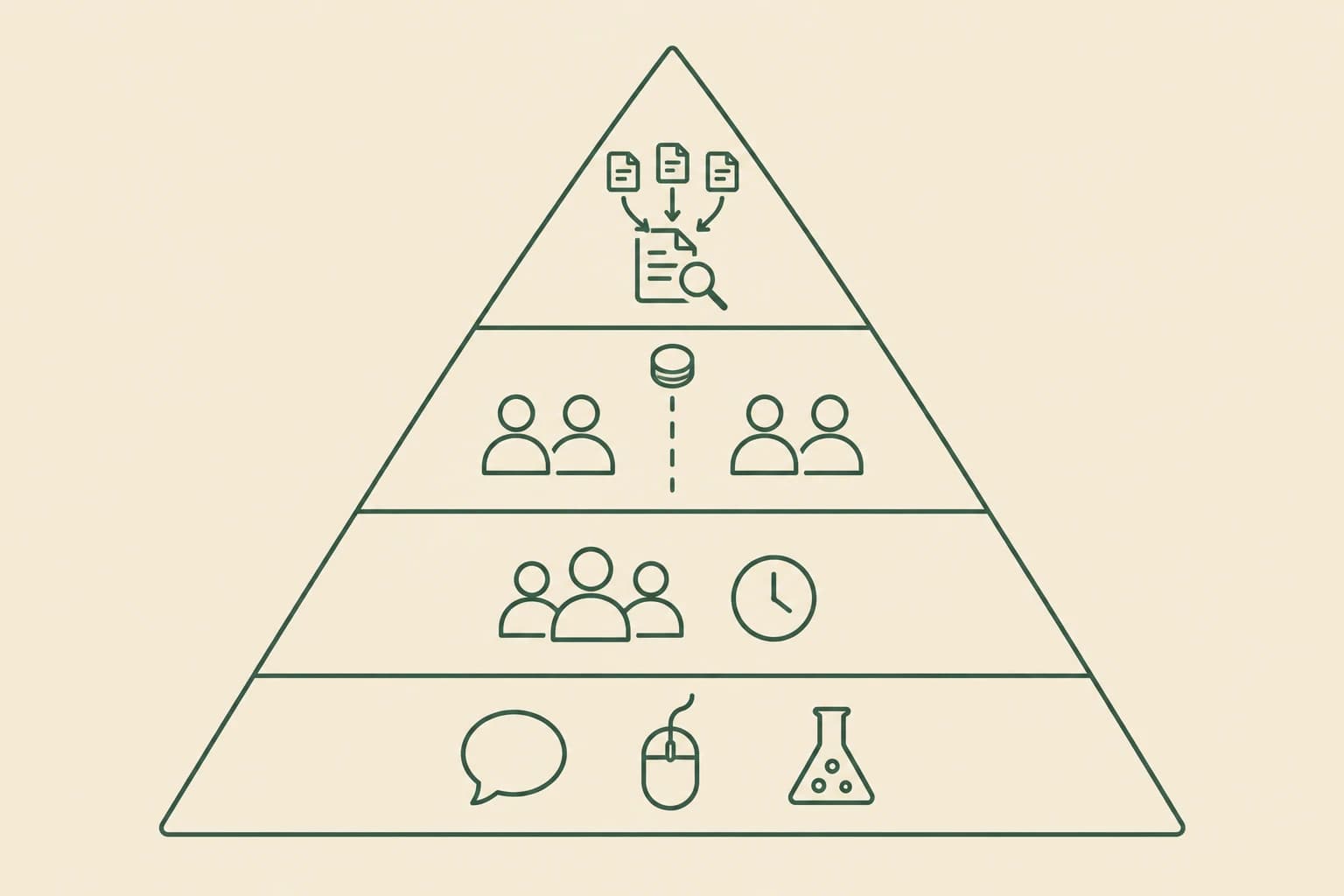
Anecdote and Expert Opinion
Before any of the formal tiers, there's evidence that never involved a controlled comparison: a single person's story, a practitioner's impression, or research done in cells or animals rather than people. None of it is worthless — a striking personal account or a lab finding is often where a real hypothesis starts. But none of it can tell you whether an effect is real, because nothing about it separates the treatment's actual effect from chance, natural recovery, the placebo effect, or whoever chose to share their story. This is also where animal and cell-culture ("in vitro") findings sit: a result in mice is real evidence about mice and a legitimate starting point for human research, but it is not evidence about people until someone tests it in people.
Observational Studies (Cohort and Case-Control)
Here, researchers stop guessing and start measuring — but they still don't assign anything. A cohort study follows a group over time and tracks what happens to those who do and don't have some exposure (a diet pattern, a job, a habit). A case-control study works backward: it starts with people who already have an outcome and compares their history against people who don't. Both are genuinely useful, sometimes the only ethical option — you cannot randomly assign people to smoke — and they're how researchers first spot patterns worth testing further.
Their real limitation is confounding: people who happen to have an exposure usually differ from those who don't in other ways too, and one of those other ways may be the real explanation for the outcome. That's why a well-run observational study can show two things are associated without showing that one caused the other — a distinction we try to hold onto in our own reporting on the shaky evidence tying everyday stress to "cortisol belly."
Randomized Controlled Trials
A randomized controlled trial (RCT) assigns participants to a treatment or a comparison group — often a placebo or standard care — using a random process, like a coin flip. That single design choice is what makes RCTs stronger than observational studies for testing whether something works: randomization spreads out differences between people evenly across groups, including differences nobody thought to measure. Blinding, where participants and sometimes researchers don't know who received which group, adds a further layer of protection against bias in how outcomes get reported (InformedHealth.org / IQWiG).
A single RCT is still a single study. It can be well designed and still return a fluke result, or one specific to the exact people, dose, or product tested — which is why the next tier exists.
Systematic Reviews and Meta-Analyses
A systematic review is a structured, criteria-based summary of every study that meets a defined bar on a specific question — not a writer's personal reading list, but a documented search-and-selection process another researcher could repeat. A meta-analysis goes further: it statistically pools the numeric results of multiple similar trials into one combined estimate, narrowing the uncertainty around the true effect and reducing the odds that one outlier trial drives the conclusion. UC Davis's and Mount Sinai's guides and the Hospital Pediatrics methodology article all place systematic reviews and meta-analyses at the top for the same reason: they represent many independent research groups' work, not one. (Researchers also have more formal versions of this idea — GRADE rates the certainty of a pooled finding as high, moderate, low, or very low, and the Cochrane risk-of-bias tool appraises individual trials for specific flaws. This four-tier ladder is the plain-language version of the same underlying logic.)
One honest caveat, straight from the researchers who study this: a hierarchy is a starting point, not a replacement for reading the actual study. The Hospital Pediatrics authors note it still has to be weighed "in context of individual study limitations through meticulous critical appraisal of individual articles" — a large, careful cohort study can outrank a small, poorly run trial, even though trials sit higher on the ladder in general (Wallace et al., 2022).
Five Questions to Ask About Any Health Study
You don't need to classify every study you encounter by name. These five questions get you most of the way to the same judgment.

Was it in humans, animals, or a test tube?
This is the single most common gap between a headline and reality. A result "in mice" or "in cells" is real preclinical evidence and a legitimate reason to study something further in people — but most compounds and effects that look promising in animal or lab research don't hold up the same way once tested in humans. If a claim doesn't say "in people," assume it hasn't been.
How many people were in it?
There's no universal minimum, but the logic is simple: the smaller the true effect you're trying to detect, the more participants you need to trust that what you're seeing isn't chance (InformedHealth.org / IQWiG). A trial of a dozen people can still be a legitimate pilot study — it just can't rule out a modest effect, and has essentially no power to catch a rare side effect. Treat small-study findings as preliminary until a larger trial or pooled analysis confirms them.
Was there a control group, and was it randomized?
A study without a comparison group can't tell you whether people would have improved anyway. A comparison group that wasn't randomly assigned can't fully rule out the confounding problem described above. Look for both — a control group, and random assignment to it — before treating a result as evidence that a specific intervention caused a specific outcome.
Who funded it, and is that disclosed?
Reputable papers disclose funding sources and author conflicts of interest, usually near the end of the article. A company-funded trial isn't automatically wrong — some of the best-replicated supplement research comes from industry-funded trials that were independently designed and honestly reported. But it's worth knowing, and it's a reason to weigh one industry-funded study alongside independent confirmation rather than on its own.
Has it been replicated, or is this the only study saying this?
One study, however well designed, is one data point. Real replication means a different research team, ideally a different specific product or population, reaching a similar conclusion independently — not just a second paper existing somewhere. A finding replicated this way deserves far more confidence than a striking result nobody else has reproduced.
Red Flags That a "Study" Isn't Strong Evidence
A few patterns show up often enough in health coverage that they're worth watching for on their own:
- A single small study is reported as if it "proves" something. Strong language ("proves," "confirms," "settles the debate") almost never matches what one study, on its own, can actually support.
- Animal or lab ("in vitro") research is described as though it already applies to people. Watch for the word "may" doing a lot of quiet work, or for it being dropped entirely between the study and the headline.
- The claim jumps from "associated with" to "causes." This is the single most common overreach in observational research coverage.
- There's no sign of peer review — a press release, a conference abstract, or a preprint with no published, reviewed paper behind it.
- A dramatic result hasn't been replicated by anyone else, especially if it contradicts a larger existing body of evidence.
- Funding or authorship sits entirely with whoever benefits from a positive result, with no independent group having confirmed the finding.
- "Miracle," "breakthrough," or "doctors don't want you to know" framing is doing the work that evidence should be doing.
None of these automatically make a study wrong. They're reasons to read a little further before you accept the headline's version of events.
Applying This to Real Coverage
The framework above is only useful if you can actually apply it. Here's what it looks like against two real health claims, both covered in full elsewhere on this site.
Ashwagandha's Scientific Evidence
Our full evidence review of ashwagandha is a genuinely mixed case, which is why it's useful here. Stress reduction and sleep quality sit at the top of the ladder: a 2025 meta-analysis pooled 15 randomized trials and 873 participants for stress and cortisol, and a 2021 meta-analysis pooled 5 trials and 400 participants for sleep — real replication, at the systematic-review tier. Menopause symptom relief sits one tier down: two genuinely positive randomized trials, but both run in the same country, using the same branded extract, supplied free by the same manufacturer — real evidence, not yet independently replicated by a different team or product. Weight loss and "women over 50" as a category sit at the bottom: thin, inconsistent, or absent dedicated trials. One herb, three evidence tiers, depending on the specific claim — which is why "is it backed by science" is the wrong question, and "backed by what evidence, for which claim" is the right one.
That review also puts the funding question into practice: several of the strongest trials had extract supplied free by the manufacturer, and two had authors directly employed by the supplement company involved — all disclosed by the authors themselves, the system working as intended, not a reason to discard the findings. It also features a trial with no significant difference from placebo on its own primary outcome, reported honestly alongside the positive trials rather than left out — what an evidence base that isn't cherry-picked actually looks like.
Cortisol Belly
Our review of "cortisol belly" shows the opposite failure mode: a popular claim resting on weaker evidence than its confident tone suggests. The idea that everyday stress raises cortisol enough to specifically target fat to your midsection is not well supported for most people — a senior Johns Hopkins endocrinologist told WebMD plainly that the underlying cause-and-effect story "is not supported by evidence." The research is genuinely mixed rather than simply negative: a 2021 meta-analysis found abdominal fat was associated with a long-run cortisol marker (hair cortisol) but not a short-term one (the cortisol awakening response), while a 2015 review called the broader literature "inconclusive." All of that evidence is observational — association, not proof of cause — precisely the distinction this guide's second tier is built around. There is a real, pathological version of high cortisol reshaping the body (Cushing's syndrome), but it's an uncommon condition confirmed by lab testing, not a shape you diagnose by looking in a mirror. Same starting claim, very different evidence tiers depending on exactly what's being asserted.
How The Wellness Voyage Applies This
We're not doctors, and this article isn't a substitute for one. What we try to do consistently is describe how settled a piece of evidence actually is rather than borrow more certainty than it has earned — strong evidence described as strong, mixed evidence described as mixed, a gap in the research described as a gap rather than papered over. That's the standard in our editorial policy, and it's what both worked examples above show in practice: one herb with genuinely strong evidence for some claims and thin evidence for others, and one popular idea whose evidence turns out weaker, and more interesting, than the confident version usually presented.
Frequently Asked Questions (FAQ)
What's the difference between a randomized controlled trial and an observational study? In a randomized controlled trial, researchers assign participants to groups — treatment versus placebo or standard care — using a random process, which spreads both known and unknown differences between people evenly across groups. In an observational study, researchers don't assign anything; they measure what's already happening and compare outcomes between people who differ naturally. That's why observational studies are good at spotting patterns worth investigating, but weaker at proving that one thing caused another.
Does "published in a peer-reviewed journal" automatically mean a study is trustworthy? No. Peer review is a real quality filter — other researchers check the methods before publication — but it's a floor, not a ceiling. It doesn't guarantee a large sample, a randomized design, independent replication, or freedom from bias in which outcomes got reported. A single small peer-reviewed study and a peer-reviewed meta-analysis of 20 pooled trials are both "peer-reviewed," but they carry very different weight.
Why do systematic reviews and meta-analyses rank above individual RCTs? Because they combine multiple independent trials instead of relying on one. Any single RCT, however well designed, could return a fluke result or reflect something specific to its dose, product, or population. A systematic review pools evidence from many trials into one documented picture; a meta-analysis statistically combines their numeric results into a single estimate, narrowing the uncertainty around the true effect.
Is a study with a small sample size automatically bad? Not automatically, but it's more limited. A well-designed small trial can genuinely detect a large effect, and it's often the necessary first step before a bigger trial gets funded. What it can't do is rule out a modest effect or catch a rare side effect — those need a much larger trial, or years of real-world use, to surface. Treat a small study's finding as preliminary, especially before it's been repeated elsewhere.
How can I tell if a study's funding source might be biasing its conclusions? Reputable papers disclose funding and conflicts of interest, usually near the end of the article. Look for who paid for the study, who supplied the product tested, and whether any author is directly employed by the company involved. None of that automatically makes a result false, but it's a reason to weigh that study alongside independent replication — especially if every positive finding on a topic traces back to the same funder.
If one study contradicts many others, should I believe the new one? Usually not right away. A study that breaks from an established pattern is more often a statistical outlier, a methodology difference, or an artifact of its specific population than a genuine overturn of everything before it — though real overturns do happen. Treat it as a signal that more research is needed, not a reason to discard the existing evidence, unless and until it's independently replicated.
How we made this guide: Researched and written by The Wellness Voyage editorial team, grounded in evidence-based-medicine guides from UC Davis and Mount Sinai's medical libraries, a peer-reviewed methodology article, and a consumer health-information resource — all linked throughout and listed below. It's meant as a literacy tool for reading health claims more carefully, not as training that qualifies anyone to independently evaluate clinical research, and not as a substitute for a qualified healthcare provider's guidance on your own health decisions.
Medical disclaimer: This article is for informational purposes only. Always consult a qualified healthcare provider before making changes to your health routine.
Sources
- In brief: How is the quality of studies assessed? — InformedHealth.org, Institute for Quality and Efficiency in Health Care (IQWiG) — NCBI Bookshelf. https://www.ncbi.nlm.nih.gov/books/NBK390294/
- Levels of Evidence — Systematic Reviews guide, University of California, Davis, Library. https://guides.library.ucdavis.edu/systematic-reviews/levels-of-evidence
- The Evidence Hierarchy — Evidence Based Medicine guide, Levy Library, Icahn School of Medicine at Mount Sinai. https://libguides.mssm.edu/ebm/hierarchy
- Wallace SS, Barak G, Truong G, Parker MW. Hierarchy of Evidence Within the Medical Literature. Hospital Pediatrics, 2022;12(8):745-750 — PubMed. https://pubmed.ncbi.nlm.nih.gov/35909178/
All sources accessed 18 September 2026.

Sophia Martinez
A wellness researcher focused on what the evidence actually says.