
Rehmannia is one of the most-used roots in Traditional Chinese Medicine (TCM), where it almost always appears inside formulas rather than on its own. What makes it unusual among single herbs is that processing doesn't just change its strength — steaming turns it into a chemically different substance used for close to the opposite pattern. Most rehmannia research is still preclinical, but unlike many single herbs, it also has a small number of real human randomized trials, mainly in kidney disease — and that split between "no human data yet" and "some human data exists" is worth understanding form by form and claim by claim, rather than as one blanket verdict.
One root, two medicines: raw vs. steamed rehmannia
Rehmannia is the root of Rehmannia glutinosa, sometimes called Chinese foxglove. A 2008 review identified more than 70 compounds in the root, including iridoid glycosides (catalpol is the most studied) and phenylethanoid glycosides such as acteoside, and documented pharmacological activity across the blood, immune, hormonal, cardiovascular, and nervous systems — mostly from lab and animal work (Zhang et al., 2008).
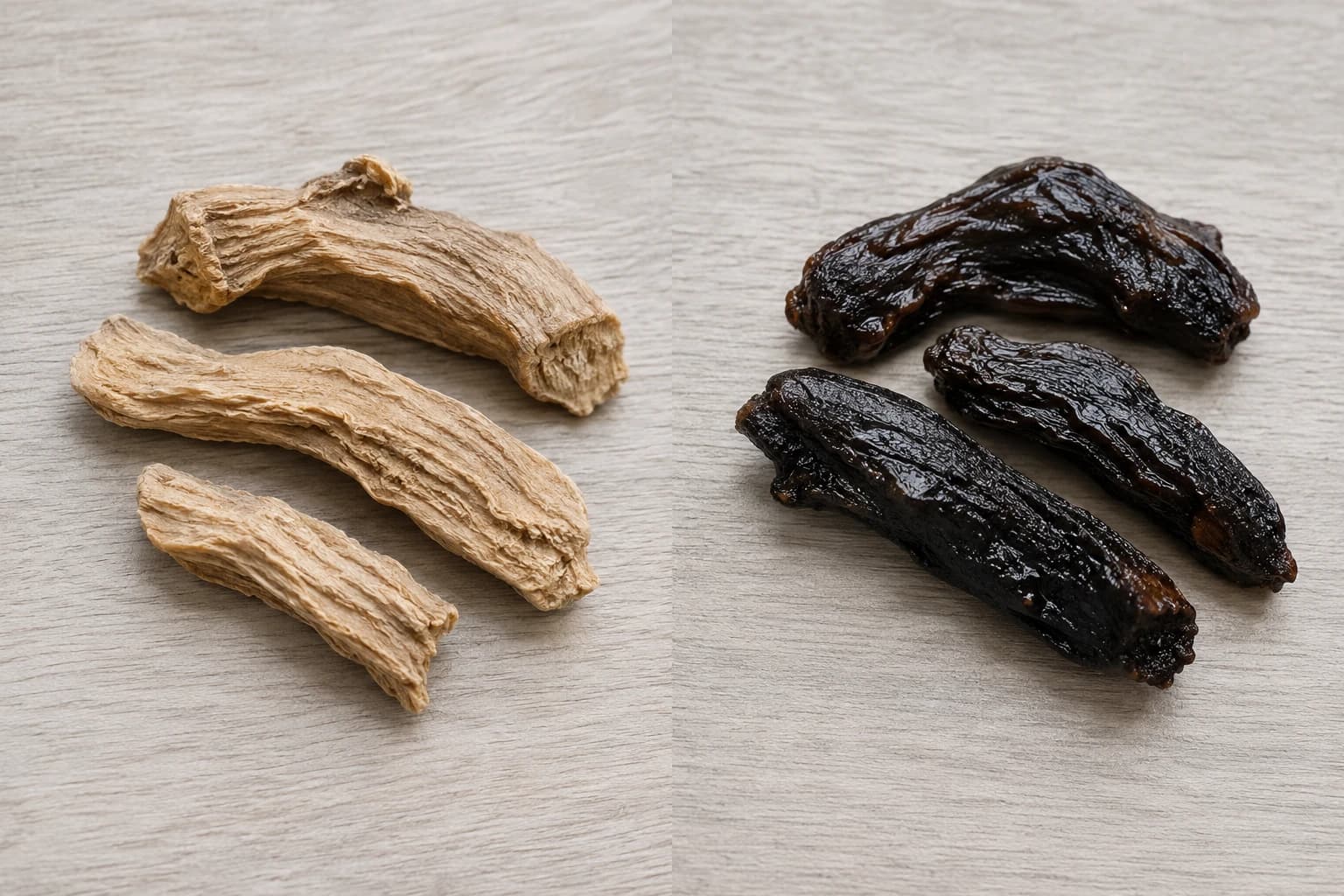
What sets rehmannia apart from most other single herbs in this category is that the same root becomes two different medicines depending on how it's processed, and TCM treats the two as having close to opposite effects:
- Sheng Di Huang (raw rehmannia): the dried, unprocessed root. Classified in TCM as cold in nature, it is used to clear heat and cool the blood. Traditional indications include blood-heat patterns such as skin eruptions and nosebleed, high fever with thirst and dry mouth, and yin-deficiency heat with a low-grade fever (D'Alberto, Sheng Di Huang monograph).
- Shu Di Huang (prepared rehmannia): the same root steamed and sun-dried repeatedly, traditionally through multiple cycles with rice wine, until it turns black, oily, and sticky. This flips its classified nature to slightly warm, and its traditional use shifts to nourishing blood and yin and "filling the essence" — used for fatigue, anemia-type paleness, and kidney-yin-deficiency patterns such as tinnitus (Me & Qi, Shu Di Huang monograph).
This isn't just traditional theory layered onto one ingredient — it tracks a real, measurable chemical change. A 2022 laboratory study found that steaming breaks down catalpol and, through the Maillard reaction, generates new compounds such as 5-HMF, measurably changing the root's chemistry and antioxidant activity (Rahmat et al., 2022). So raw and prepared rehmannia really are different products, and the "opposite" traditional uses correspond to an actual shift in composition rather than an arbitrary label.
The lab evidence: what catalpol does in cells and animals
Most of what's known about rehmannia's pharmacology comes from catalpol, the iridoid concentrated in the raw root, and it comes from cells and animals rather than people.
- Anti-inflammatory and neuroprotective signals. In cell and animal models, catalpol lowers inflammatory markers such as TNF-alpha and IL-6 and protects neurons from oxidative stress, acting through pathways including NF-kB inhibition and Nrf2 activation (Yang et al., 2020). These are promising mechanisms, not evidence of benefit in people.
- Blood sugar: animal data only. Catalpol also lowers blood sugar in rodent diabetes models. A 2019 review of catalpol's biological effects states plainly that "there have been no clinical studies to examine its effects in the human" for this use — the diabetes evidence rests entirely on animal and cell research (Bhattamisra et al., 2019). Despite what some rehmannia articles imply, there is no human trial showing the herb, or catalpol specifically, treats type 2 diabetes. Don't use it as a substitute for diabetes care, and see the interactions note below if you take glucose-lowering medication.
The human trials that do exist: rehmannia in kidney-disease formulas
Unlike the diabetes claim above, rehmannia does have a small amount of real human randomized-trial evidence — specifically around chronic kidney disease, and specifically as part of a formula or a drug-combination, not as a stand-alone raw or prepared root taken by itself.
- A randomized controlled trial of 479 people with primary chronic glomerulonephritis compared irbesartan (an ARB blood-pressure drug) alone against irbesartan plus Rehmannia glutinosa acteosides — an extracted compound fraction, not the whole dried root. After 8 weeks, the combination group had a significantly larger drop in 24-hour proteinuria (36.42% reduction from baseline) than the irbesartan-alone group (27.97%, P = 0.0278), with similarly low rates of adverse effects in both groups (Qiu et al., 2014).
- A separate multicenter RCT in Hong Kong tested modified "Rehmannia-6"-based Chinese medicine granules — built on the same six core ingredients as the classic formula Liu Wei Di Huang Wan mentioned above (prepared rehmannia, Fructus Corni, Dioscorea, Poria, Cortex Moutan, and Alisma) — added on top of standard care in 148 people with type 2 diabetes and stage 2–3 CKD. Over 48 weeks, the treatment group's eGFR declined 2.7 mL/min/1.73m² per year less than controls, though there was no statistically significant difference in albuminuria between groups (Chan et al., 2023).
Two honest caveats apply to both trials. First, neither tested the single herb alone: one used an isolated extract fraction paired with a prescription drug, the other a multi-herb formula added to standard medical care. Second, the second trial's benefit only showed up on one kidney-function measure (eGFR decline) and not on another (albuminuria). Even with those caveats, this is a meaningfully different evidence tier than the diabetes claim above — these are real randomized trials in humans, not animal studies — though nothing here supports replacing prescribed CKD treatment with rehmannia on your own.
Dosage and formula use
Rehmannia is almost always used in combination formulas, not alone, and the dose depends on which form is used:
- Raw (Sheng Di Huang): commonly dosed around 10–15 g/day of dried root in decoction, sometimes higher under supervision for acute heat patterns.
- Prepared (Shu Di Huang): typically 9–30 g/day, occasionally up to 60 g under practitioner supervision for severe deficiency patterns (Me & Qi, Shu Di Huang monograph).
It appears in classic formulas such as Liu Wei Di Huang Wan, combined with several other herbs at set ratios (Zhang et al., 2008) — the same core combination used in the CKD trial above. For other roots used in related formulas, see our guides to white peony and bupleurum. Because the form and dose are matched to a specific pattern, rehmannia is best used under a qualified TCM practitioner rather than self-prescribed.
Side effects, interactions, and who should avoid it
- Digestive upset: loose stools, bloating, or mild nausea are the most reported effects, more so with raw rehmannia and in people with weak digestion.
- Diabetes medicines: because catalpol lowers blood sugar in animals, anyone on insulin or glucose-lowering drugs should check with their prescriber before use, to avoid an additive effect.
- Blood pressure medicines: rehmannia may lower blood pressure, and combining it with blood-pressure-lowering drugs could cause an additive drop; monitor blood pressure and check with a prescriber first (WebMD, Rehmannia monograph).
- Before surgery: because of its possible effect on blood sugar control, stop use at least two weeks before a scheduled surgery (WebMD, Rehmannia monograph).
- Pregnancy and breastfeeding: safety is not established, so avoid it.
- Serious conditions: do not use rehmannia in place of treatment for diabetes, kidney disease, or any diagnosed illness. If you take prescription medicines, check for interactions first.
For background on using herbs and TCM safely, see NCCIH.
Frequently Asked Questions (FAQ)
What is the difference between Sheng Di Huang and Shu Di Huang? Sheng Di Huang is the raw root (cool in TCM terms, used for heat and blood-heat patterns); Shu Di Huang is the same root steamed repeatedly (warm, used for blood/yin-deficiency patterns like fatigue). Steaming measurably changes the chemistry, which is part of why they're used differently.
Does rehmannia lower blood sugar? Its compound catalpol lowers blood sugar in animal studies, but there are no human trials confirming this for rehmannia or catalpol. Do not use it to manage diabetes on your own, and if you take diabetes medicines, ask your doctor first.
Is there real evidence rehmannia helps kidney disease? There are two human randomized controlled trials: one combining an extracted rehmannia compound with the drug irbesartan for chronic glomerulonephritis, and one adding a rehmannia-based formula to standard care for diabetic CKD. Both showed benefits on some measures, but neither tested rehmannia alone, and neither is a reason to replace prescribed kidney-disease treatment.
Can rehmannia be combined with white peony? Yes, they are often combined in classic formulas, but the right ratio and use should be set by a qualified practitioner.
Medical disclaimer: This article is for informational purposes only. Always consult a qualified healthcare provider before making changes to your health routine.
Sources
- Zhang RX, et al. Rehmannia glutinosa: review of botany, chemistry and pharmacology. Journal of Ethnopharmacology, 2008;117(2):199-214 — PubMed. https://pubmed.ncbi.nlm.nih.gov/18407446/
- Rahmat E, et al. Evaluation of Marker Compounds and Biological Activity of In Vitro Regenerated and Commercial Rehmannia glutinosa Roots Subjected to Steam Processing. Evidence-Based Complementary and Alternative Medicine, 2022 — PubMed Central. https://pmc.ncbi.nlm.nih.gov/articles/PMC9763011/
- Yang C, et al. Neuroprotective Effect of Catalpol via Anti-Oxidative, Anti-Inflammatory, and Anti-Apoptotic Mechanisms. Frontiers in Pharmacology, 2020 — PubMed Central. https://pmc.ncbi.nlm.nih.gov/articles/PMC7240050/
- Bhattamisra SK, et al. Multiple Biological Effects of an Iridoid Glucoside, Catalpol, and Its Underlying Molecular Mechanisms. Biomolecules, 2019 — PubMed Central. https://pmc.ncbi.nlm.nih.gov/articles/PMC7023090/
- Qiu H, et al. Treatment of primary chronic glomerulonephritis with Rehmannia glutinosa acteosides in combination with the angiotensin receptor blocker irbesartan: a randomized controlled trial. Phytotherapy Research, 2014 — PubMed. https://pubmed.ncbi.nlm.nih.gov/23519822/
- Chan KW, et al. Add-on Rehmannia-6-Based Chinese Medicine in Type 2 Diabetes and CKD: A Multicenter Randomized Controlled Trial. Clinical Journal of the American Society of Nephrology, 2023;18(9):1163-1174 — PubMed Central. https://pmc.ncbi.nlm.nih.gov/articles/PMC10564374/
- D'Alberto A. Sheng Di Huang (Raw Rehmannia Root) monograph. attiliodalberto.com. https://www.attiliodalberto.com/chinese-herbal-medicine/herbs/sheng-di-huang.php
- Me & Qi. Shu Di Huang (Prepared Rehmannia Root) monograph. meandqi.com. https://www.meandqi.com/knowledge-base/herbs/shu-di-huang
- WebMD. Rehmannia: Overview, Uses, Side Effects, Precautions, Interactions, Dosing. https://www.webmd.com/vitamins/ai/ingredientmono-1155/rehmannia
- National Center for Complementary and Integrative Health (NCCIH). Traditional Chinese Medicine: What You Need To Know. https://www.nccih.nih.gov/health/traditional-chinese-medicine-what-you-need-to-know
All sources accessed 10 July 2026.

Emily Johnson, MSc, RH (AHG)
Registered Herbalist (AHG) specializing in natural remedies and medicinal plants, with a focus on the traditional and evidence-based uses of healing herbs.