
Korean mint is an aromatic herb used in East Asian cooking and in Traditional Chinese Medicine, where it is called Huo Xiang. It has a pleasant anise-like scent and a long record of traditional use for digestion. Its essential oil is dominated by a compound called estragole, which European regulators have formally assessed and assigned specific numeric safety guidance to — precise enough to be worth leading with rather than saving for last. This guide starts with that safety picture, then covers what the lab and human research on Korean mint itself actually show.
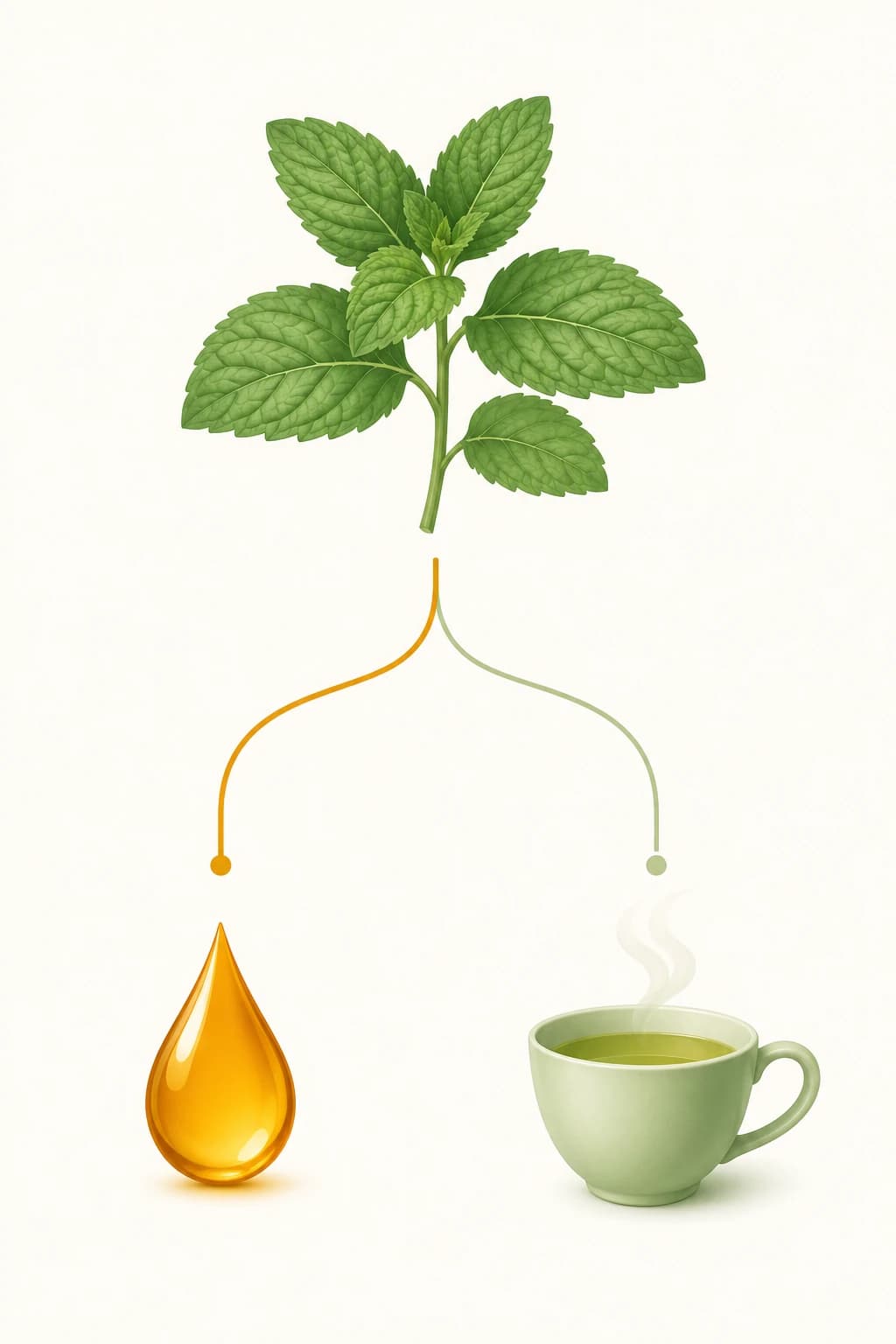
What Korean mint actually is: one plant, two chemical stories
Korean mint is Agastache rugosa, a plant in the mint family (Lamiaceae) — not related to ragweed or daisies. The leaves and flowers are the parts used. In Chinese medicine it is described as acrid and warming and grouped with herbs that "transform dampness"; traditionally it has been used for nausea, vomiting, a bloated stomach, and the early stage of colds with digestive upset (Nechita et al., 2023). In Korea the leaves are also eaten fresh as a fragrant kitchen herb.
Chemically, Korean mint has two distinct profiles worth separating out:
- The essential oil — the source of its anise-like aroma — is dominated by estragole (also called methylchavicol), reported at anywhere from about 18.6% to over 98% of the oil across studies of A. rugosa and its close relative A. foeniculum, along with smaller amounts of compounds such as limonene (Zielińska & Matkowski, 2014). This is the compound behind the safety section below.
- The leaf itself, apart from the oil, is rich in non-volatile polyphenols — rosmarinic acid and the flavones acacetin and tilianin (acacetin-7-glucoside) — which is what most of the newer research on Korean mint's other effects is actually testing (Zielińska & Matkowski, 2014; Lee et al., 2023).
The estragole question: what the safety evidence actually says
Estragole is the reason Korean mint has a more precisely documented safety profile than most herbs get. It also occurs in basil, tarragon, and fennel, and European regulators have formally evaluated it more than once.
The European Medicines Agency's Committee on Herbal Medicinal Products (HMPC) concluded, after a multi-year re-assessment finished in 2021 and published in 2022, that estragole is "a naturally occurring genotoxic carcinogen with a DNA potency similar to safrole" (EMA/HMPC, Public statement on the use of herbal medicinal products containing estragole). The concern is dose-dependent: at high doses the body converts some estragole into a reactive metabolite that can bind to DNA; the same assessment notes that this activation "diminishes markedly" at low levels of exposure.
Because the available data didn't support a single hard cutoff, the HMPC instead published specific guidance values for herbal medicinal products containing estragole:
- Adults and adolescents: no more than 0.05 mg of estragole per day, and only for short-term use (a maximum of 14 days).
- Children up to 11 years: no more than 1.0 microgram of estragole per kg of body weight per day.
- Pregnancy and breastfeeding: use is not recommended above that 0.05 mg/day guidance value unless a specific risk assessment justifies it.
Those numbers apply to concentrated herbal medicinal preparations, not to ordinary food and tea use. For context, background dietary exposure to estragole from ordinary spices and herbs has separately been estimated at roughly 0.5 to 5 mg per day in various official assessments — the HMPC guidance is deliberately conservative and aimed at avoidable, added exposure from medicinal-strength products, not at cooking or occasional tea (EMA/HMPC). No estragole measurement specific to a cup of Korean mint tea appears to exist in the literature, so that comparison can't be made precisely — but the order-of-magnitude difference between the medicinal-product guidance and typical everyday exposure is why occasional culinary and tea use is treated differently from concentrated extracts below.
What this means in practice for Korean mint:
- Avoid concentrated essential oil taken internally, and don't use high-dose extracts for long periods.
- Pregnancy and breastfeeding: despite Korean mint's traditional reputation for easing nausea, concentrated forms are best avoided given the estragole guidance above and the lack of safety data specific to Korean mint. Talk to your clinician first.
- Children: avoid the essential oil internally.
- General use: if you take prescription medicines or have a health condition, check with a healthcare professional before using concentrated Korean mint products, and don't use Korean mint in place of treatment.
For general background on herb safety, see NCCIH.
What lab research shows beyond the essential oil
Most Korean mint research beyond the estragole safety literature comes from cells and animals, not people.
A 2023 review of the genus reports that A. rugosa oil and its compounds kill bacteria and fungi in lab tests, including Staph aureus, E. coli, and Candida yeasts, with estragole driving much of that effect. In animals, extracts protected the stomach lining in mice and eased swelling in a rat arthritis model. The same review states plainly that human studies are missing (Nechita et al., 2023).
Newer research has also started looking specifically at the leaf's polyphenols rather than the oil. A 2024 cell-culture study found that Korean mint extract and its flavone tilianin helped preserve protein balance in cultured mouse muscle cells (C2C12 myotubes) under atrophy-inducing conditions, acting through the PI3K/Akt/FoxO3 signaling pathway and reducing markers of inflammation and oxidative stress (Woo et al., 2024). This is cell-culture evidence only — it hasn't been tested in animals or people — but it shows that research interest in Korean mint now extends past digestion and infection into its specific flavone content.
Bottom line: the digestive, antimicrobial, and muscle-related signals are all preclinical. None of this proves Korean mint treats an infection or a muscle condition in people.
What actual human studies have found
Human evidence for Korean mint is small, and it splits into two very different kinds of study — neither of which tests whether Korean mint treats a medical condition.
The first is an aromatherapy study: in 38 healthy adults, simply inhaling Korean mint essential oil shifted brain-wave activity (more alpha, less theta), which the authors linked to feeling more alert and focused (Hong et al., 2022). That is a short-term effect of smelling the oil, not evidence that drinking or swallowing the herb treats anything.
The second is a bioavailability study: in a small randomized, double-blind, crossover trial, 10 healthy women drank either a Korean mint extract or a placebo, and researchers tracked their blood over six hours. The extract's characteristic compounds showed up in blood plasma, confirming they are actually absorbed after oral intake — rosmarinic acid and tilianin were most abundant 2 to 3 hours after drinking the extract before gradually declining, while acacetin appeared later and kept rising throughout the full 6-hour measurement window (Lee et al., 2023). The study's own authors describe it as preliminary, and it measured absorption, not any health outcome — it doesn't show that Korean mint improved anything in these participants, only that its compounds reach the bloodstream.
Bottom line: real human data exists for Korean mint, but it's limited to a short-term aromatherapy effect and a small pharmacokinetic study — not a clinical trial testing whether the herb treats a condition.
Traditional, culinary, and medicinal use today
Outside the lab, Korean mint is mostly used as a food, a tea, or within a herbal formula rather than as a high-dose extract.
- Tea: the dried leaf steeped briefly in hot water. Cooking it too long drives off the aromatic oils.
- In formulas: practitioners pair it with other herbs for nausea and damp-stomach patterns; traditional dosing is roughly 4.5 to 9 grams of dried herb (or more when fresh) within a formula.
- Culinary: fresh leaves as a fragrant herb in Korean dishes.
This casual, food-level use is a different category of exposure from the concentrated essential oil or high-dose capsules covered in the estragole section above — that section's numeric guidance applies most directly to those concentrated forms. For general tips on brewing a stronger, better-extracted cup, see our herbal tea benefits guide.
For other herbs used in the same traditions, see our guides to Ju Hua (chrysanthemum flower) and bupleurum.
Frequently Asked Questions (FAQ)
What is Korean mint good for? Traditionally it is used for nausea, a bloated or upset stomach, and early colds with digestive symptoms. Lab and animal studies show antimicrobial and gastroprotective activity, but human treatment evidence is limited.
How much estragole is safe, and does that mean Korean mint tea is risky? European regulators' guidance value for herbal medicinal products is 0.05 mg of estragole per day for adults, for a maximum of 14 days (EMA/HMPC). That guidance is aimed at concentrated preparations, not ordinary tea or cooking use — a normal cup of leaf tea is generally well tolerated. The specific concern is with concentrated essential oil and high-dose extracts.
Can I take Korean mint during pregnancy for nausea? It has a traditional reputation for this, but concentrated forms are best avoided in pregnancy given the estragole guidance above and the lack of safety data specific to Korean mint. Ask your clinician before using it.
Does Korean mint help focus? One small human study found that inhaling the essential oil shifted brain waves toward an alert state. That is a short aromatherapy effect, not a proven treatment.
Is there real human evidence for Korean mint, or is it all animal and lab data? Two small human studies exist: one on brain-wave changes from smelling the oil, and one tracking how the leaf's polyphenols appear in blood after drinking an extract. Neither tested whether Korean mint treats a health condition.
Medical disclaimer: This article is for informational purposes only. Always consult a qualified healthcare provider before making changes to your health routine.
Sources
- Nechita MA, et al. Agastache Species: A Comprehensive Review on Phytochemical Composition and Therapeutic Properties. Plants (Basel), 2023 — PubMed Central. https://pmc.ncbi.nlm.nih.gov/articles/PMC10459224/
- Zielińska S, Matkowski A. Phytochemistry and bioactivity of aromatic and medicinal plants from the genus Agastache (Lamiaceae). Phytochemistry Reviews, 2014 — PubMed Central. https://pmc.ncbi.nlm.nih.gov/articles/PMC4032471/
- Hong M, et al. Changes in Human Electroencephalographic Activity in Response to Agastache rugosa Essential Oil Exposure. Behavioral Sciences (Basel), 2022 — PubMed Central. https://pmc.ncbi.nlm.nih.gov/articles/PMC9311756/
- European Medicines Agency (EMA), Committee on Herbal Medicinal Products (HMPC). Public statement on the use of herbal medicinal products containing estragole (EMA/HMPC/137212/2005 Rev. 1), Final; adopted 22 September 2021, published 1 March 2022. https://www.ema.europa.eu/en/use-herbal-medicinal-products-containing-estragole-scientific-guideline
- Lee YE, et al. Bioavailability of Korean mint (Agastache rugosa) polyphenols in humans and a Caco-2 cell model: a preliminary study exploring the efficacy. Food & Function, 2023;14(19):8933-8941 — PubMed. https://pubmed.ncbi.nlm.nih.gov/37723877/
- Woo YK, Kang M, Kim C, Hwang JK. Korean Mint (Agastache rugosa) Extract and Its Bioactive Compound Tilianin Alleviate Muscle Atrophy via the PI3K/Akt/FoxO3 Pathway in C2C12 Myotubes. Preventive Nutrition and Food Science, 2024;29(2):154-161 — PubMed. https://pubmed.ncbi.nlm.nih.gov/38974592/
- National Center for Complementary and Integrative Health (NCCIH). Herbs at a Glance. https://www.nccih.nih.gov/health/herbsataglance
All sources verified 10 July 2026.

Emily Johnson, MSc, RH (AHG)
Registered Herbalist (AHG) specializing in natural remedies and medicinal plants, with a focus on the traditional and evidence-based uses of healing herbs.