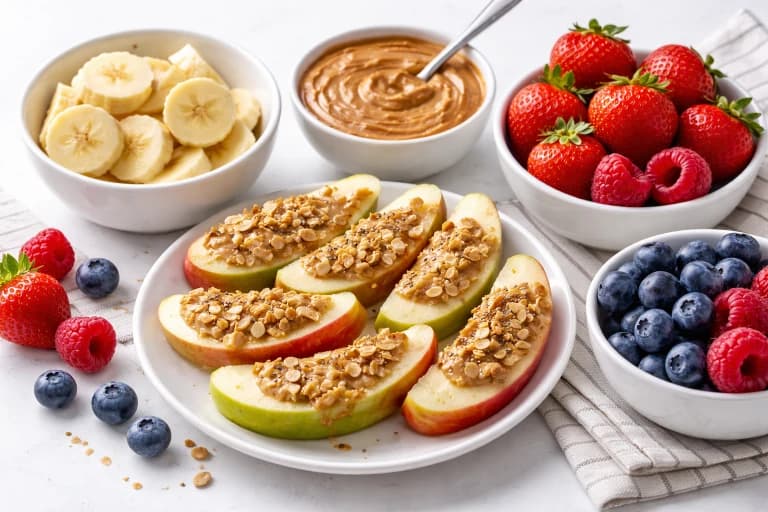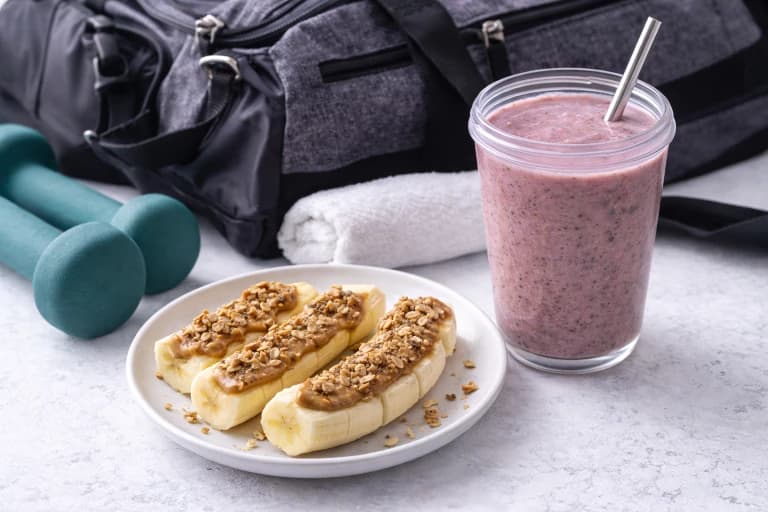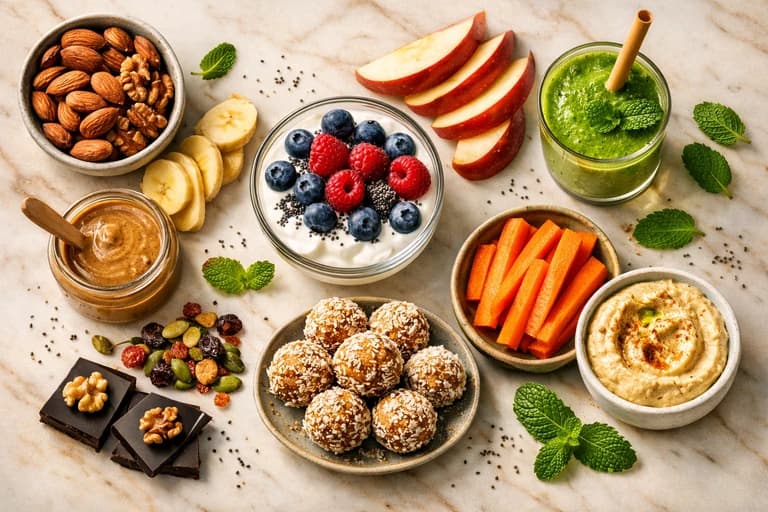
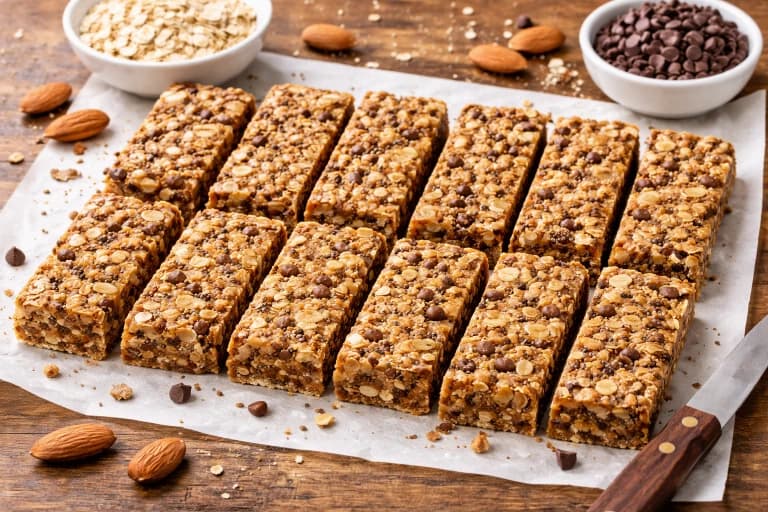
If you have ever turned a packaged bar around and found a wall of unfamiliar ingredients plus 25 grams of sugar, you already know why making your own is worth it. Homemade bars give you real food and full control over what goes in. The three no-bake recipes below are built from oats, nuts, seeds, and dates, with full measurements and per-bar nutrition you can trust.
Why make your own?
The short answer is control. Many packaged snack bars are ultra-processed, with long ingredient lists and added sugar, and diets high in ultra-processed foods are associated with worse health outcomes (Harvard Health). Making bars at home lets you set the level of sugar, lean on fiber and protein, swap out allergens, and batch a week's worth for less money than buying them.
What makes a bar satisfying
A good bar balances three things: carbohydrate for quick energy, protein for staying power, and fat for fullness. Oats and dates supply the carbohydrate and fiber; nuts and seeds add protein, fat, and minerals like magnesium and zinc.
Each part earns its place. Fiber helps a snack feel filling and steadies blood sugar; in one study, a berry snack suppressed later eating more than a sugary one (Dreher, 2018; Anderson et al., 2009). Protein adds staying power and supports muscle (Jäger et al., 2017). Nuts pack fat, plant protein, and magnesium into a small package (Ros, 2010), and magnesium and B vitamins play a direct role in turning food into energy (Tardy et al., 2020).
Store-bought vs homemade
This compares a typical store-bought granola bar with one homemade bar from this guide. The store-bought figures use the USDA FoodData Central entry for an oat-and-raisin breakfast bar, scaled to 40 g.
| Bar (approx. size) | Carbs (g) | Sugars (g) | Protein (g) | Fiber (g) |
|---|---|---|---|---|
| Store-bought granola bar (40 g) | 26.7 | 11.0 | 3.9 | 1.2 |
| Homemade Almond Cocoa bar (~43 g) | 26.0 | 11.6 | 4.6 | 4.8 |
The standout difference is fiber: the homemade bar has roughly four times as much for a similar carbohydrate and sugar count, which helps it feel more filling.
The base formula
Use this as a flexible template:
- Dry base: 1½ to 2 cups rolled oats or ground nuts
- Sticky base: 1½ to 2 cups pitted dates or thick date paste
- Fat and protein: ⅓ to ½ cup nut or seed butter
- Texture boosters: 2 to 4 tablespoons seeds, cocoa, or coconut
Technique that works:
- If your dates are firm, soak them in hot water for 5 to 10 minutes, then drain well. This helps the bar bind without extra syrup.
- Pulse the oats first until you get a mix of flour and small flakes.
- Add the rest and blend 30 to 60 seconds, scraping the bowl once. The dough should clump when pinched.
- Press into a parchment-lined 8x8-inch pan, compacting firmly with another sheet of parchment and the bottom of a glass.
- Chill at least 1 to 2 hours, or freeze 20 to 30 minutes, before slicing.
Recipe 1: Almond Cocoa Bars
Deep cocoa, nutty, lightly sweet, the classic no-bake template.
Ingredients (makes 12 bars)
- Rolled oats, dry: 180 g (about 2¼ cups)
- Medjool dates, pitted: 200 g (about 12 large)
- Almond butter, plain: 96 g (6 tablespoons)
- Unsweetened cocoa powder: 20 g (about ¼ cup)
- Chia seeds: 24 g (2 tablespoons)
- Vanilla extract: 1 teaspoon
- Fine sea salt: ¼ teaspoon
Method
- If dates are dry, soak in hot water 5 minutes, then drain well.
- Pulse oats in a food processor 6 to 8 times until coarse flour with some flakes.
- Add dates, almond butter, cocoa, chia, vanilla, and salt. Process 30 to 60 seconds until a sticky dough forms and holds when pressed.
- Press into a parchment-lined 8x8-inch pan in an even layer.
- Chill 1 to 2 hours, then slice into 12 bars.
Per-bar nutrition (estimated): ~166 kcal, ~26.0 g carbs, ~4.6 g protein, ~6.3 g fat, ~4.8 g fiber, ~11.6 g sugars. Estimated from USDA FoodData Central data for the ingredients.
Oats and dates form the carbohydrate base, while almond butter and chia add fat and protein for staying power. Cocoa adds flavor without much sugar.
Recipe 2: Cashew Coconut Bars
Creamy, buttery, lightly tropical, a softer bar.
Ingredients (makes 12 bars)
- Raw cashews: 180 g (about 1½ cups)
- Unsweetened desiccated coconut: 70 g (about ¾ cup)
- Medjool dates, pitted: 160 g (about 10 large)
- Rolled oats, dry: 80 g (about 1 cup)
- Honey: 30 g (2 tablespoons)
- Vanilla extract: 1 teaspoon
- Fine sea salt: ¼ teaspoon
Vegan swap: replace the honey with 30 g date paste (about 2 extra dates blended with a splash of warm water).
Method
- If dates are firm, soak in hot water 5 minutes and drain.
- Pulse cashews into a rough meal.
- Add coconut and oats; pulse 5 to 6 times to combine.
- Add dates, honey, vanilla, and salt. Process 30 to 60 seconds until the mixture clumps.
- Press into a parchment-lined 8x8-inch pan, compact firmly, and chill 1 to 2 hours before slicing.
Per-bar nutrition (estimated): ~191 kcal, ~22.5 g carbs, ~4.3 g protein, ~10.8 g fat, ~3.0 g fiber, ~12.3 g sugars. Estimated from USDA FoodData Central data for the ingredients.
Cashews bring a creamy texture plus magnesium and iron; unsweetened coconut adds fat and structure. Dates and a little honey bind the bar without refined sugar.
Recipe 3: Pumpkin Seed Protein Bars
Nutty, lightly fruity, with a dense, satisfying bite, the highest-protein of the three.
Ingredients (makes 12 bars)
- Pumpkin seed kernels (pepitas): 180 g (about 1½ cups)
- Rolled oats, dry: 120 g (about 1½ cups)
- Almond butter, plain: 96 g (6 tablespoons)
- Medjool dates, pitted: 160 g (about 10 large)
- Chia seeds: 24 g (2 tablespoons)
- Dried tart cherries: 60 g (about ½ cup)
- Vanilla extract: 1 teaspoon
- Fine sea salt: ¼ teaspoon
Method
- Soak dates in hot water 5 minutes if firm, then drain.
- Pulse pumpkin seeds and oats until roughly chopped.
- Add almond butter, dates, chia, cherries, vanilla, and salt. Process 30 to 60 seconds, scraping once, until the mixture clumps.
- Press into a parchment-lined 8x8-inch pan and compact firmly.
- Chill 1 to 2 hours, then slice into 12 bars.
Per-bar nutrition (estimated): ~234 kcal, ~24.7 g carbs, ~8.2 g protein, ~13.1 g fat, ~4.4 g fiber, ~12.9 g sugars. Estimated from USDA FoodData Central data for the ingredients.
Pumpkin seeds are especially rich in magnesium and zinc, while oats and dates provide the carbohydrate base. Tart cherries add a little natural sweetness and color, and they naturally contain anthocyanins.
Storage, shelf life, and variations
Store bars in an airtight container in the refrigerator, and freeze any you will not eat within a few days. For food safety, general cold-storage guidance is to keep perishable leftovers refrigerated and to freeze for longer keeping (FoodSafety.gov). If you freeze the bars, thaw them in the fridge overnight or at room temperature for 15 to 20 minutes.
Three easy variations:
- Nut-free: swap nut butter for sunflower seed butter, and use pumpkin seeds plus oats for bulk.
- Higher protein: replace 40 g of oats with extra pumpkin seeds, or add a tablespoon of chia.
- Less sweet: reduce the dates by 20 to 30 g and add more oats or coconut for structure.
Frequently Asked Questions (FAQ)
Are homemade energy bars healthier than store-bought? They can be, mainly because you control the added sugar and use whole-food ingredients. Diets high in ultra-processed foods are linked to worse health, and homemade bars help you skip those ingredients.
How do I keep the bars from falling apart? The binder is everything. Make sure the dates are soft and sticky, press the mixture firmly into the pan, and chill long enough for the bars to set.
Can I make these without a food processor? Yes, with more effort. Finely chop and mash the dates, mix with finely chopped nuts and oats, press firmly, and chill well. The texture will be chunkier.
What is the best nut butter for energy bars? Almond butter gives a mild flavor and good minerals; cashew butter is creamier. Choose one without added sugar or oils.
How should I store homemade energy bars? Keep them in an airtight container in the refrigerator, and freeze any you will not eat within a few days. Thaw frozen bars in the fridge overnight.
Medical disclaimer: This article is for informational purposes only. Always consult a qualified healthcare provider before making changes to your health routine.
Conclusion
These three no-bake bars are built for real life: simple ingredients, full measurements, and nutrition you can trust. Keep a batch in rotation for workdays, travel, or after a workout. For more ideas, see the healthy snacks for energy pillar, best nuts for sustained energy, low-carb snacks for energy, and vegan snacks for energy.
Sources
- Dreher ML. Whole fruits and fruit fiber emerging health effects. Nutrients, 2018 — PubMed. https://pubmed.ncbi.nlm.nih.gov/30487459/
- Anderson JW, et al. Health benefits of dietary fiber. Nutrition Reviews, 2009 — PubMed. https://pubmed.ncbi.nlm.nih.gov/19335713/
- Jäger R, et al. International Society of Sports Nutrition position stand: protein and exercise. Journal of the International Society of Sports Nutrition, 2017 — PubMed. https://pubmed.ncbi.nlm.nih.gov/28642676/
- Ros E. Health benefits of nut consumption. Nutrients, 2010 — PubMed Central. https://pmc.ncbi.nlm.nih.gov/articles/PMC3257681/
- Tardy AL, et al. Vitamins and minerals for energy, fatigue and cognition. Nutrients, 2020 — PubMed. https://pubmed.ncbi.nlm.nih.gov/31963141/
- USDA FoodData Central — ingredient nutrition data. https://fdc.nal.usda.gov/
- FoodSafety.gov — Cold Food Storage Charts. https://www.foodsafety.gov/food-safety-charts/cold-food-storage-charts
All sources accessed 31 May 2026.

Sophia Martinez, MS, CNS
A wellness researcher focused on what the evidence actually says.