
Most supplements promise more than they deliver. Creatine is the rare exception. It has been tested in hundreds of trials over several decades, and the results hold up: paired with training, it makes you stronger. This guide walks through what creatine is, what the evidence genuinely supports, who tends to benefit, and how to use it, without the marketing gloss.
What creatine is
Creatine is a compound your body makes from amino acids, mainly in the liver, and that you also get from meat and fish. About 95% of it is stored in your muscles as phosphocreatine. Your body produces roughly 1 to 2 grams a day on its own.
Its job is energy. During short, hard efforts, like a heavy set or a sprint, your muscles burn through their immediate fuel (ATP) in seconds. Phosphocreatine helps regenerate that fuel quickly, so you can push a little harder before fatigue sets in. Supplementing raises the amount of creatine stored in muscle, which gives you a bigger energy buffer for high-intensity work (Kreider et al., 2017).
It is worth being clear about what creatine is not. It is not a steroid or a hormone. It is not a stimulant. And it is not a fat-burner. It simply tops up a compound your body already uses.
What the evidence actually shows
This is where creatine earns its reputation.
Strength and power
The strongest evidence is for high-intensity exercise. A review of 22 studies found that adding creatine to resistance training raised muscle strength gains by about 8 percentage points over training plus a placebo (a 20% improvement versus 12%), and weightlifting performance by about 14 points (Rawson & Volek, 2003). The response varies a lot between people, but the overall direction is consistent across the literature. Creatine does not build muscle on its own; it lets you do slightly more work, and that extra work, repeated over time, drives the result.
Brain and cognition
Creatine also fuels the brain, which has led researchers to test it for mental performance. In one double-blind trial, vegetarians taking 5 grams a day for six weeks improved on tests of working memory and reasoning (Rae et al., 2003). The effect appears largest in people who start with low creatine stores, such as vegetarians or those who are sleep-deprived. This is a genuine and active area of research, but it is younger and less settled than the exercise evidence, so it is best treated as promising rather than proven.
Who tends to benefit
- People doing resistance or high-intensity training. This is the clearest case, for both newer and experienced trainees.
- Vegetarians and vegans. Because they get little or no creatine from food, their muscle stores start lower, and they often respond more.
- Women. A review of creatine across the female lifespan found benefits for strength and exercise performance, with effects on mood and, in post-menopausal women combined with resistance training, on bone (Smith-Ryan et al., 2021). We cover this in detail in our guide to creatine for women.
- Older adults. Combined with resistance training, creatine is being studied for muscle and functional health with age.
Is creatine safe?
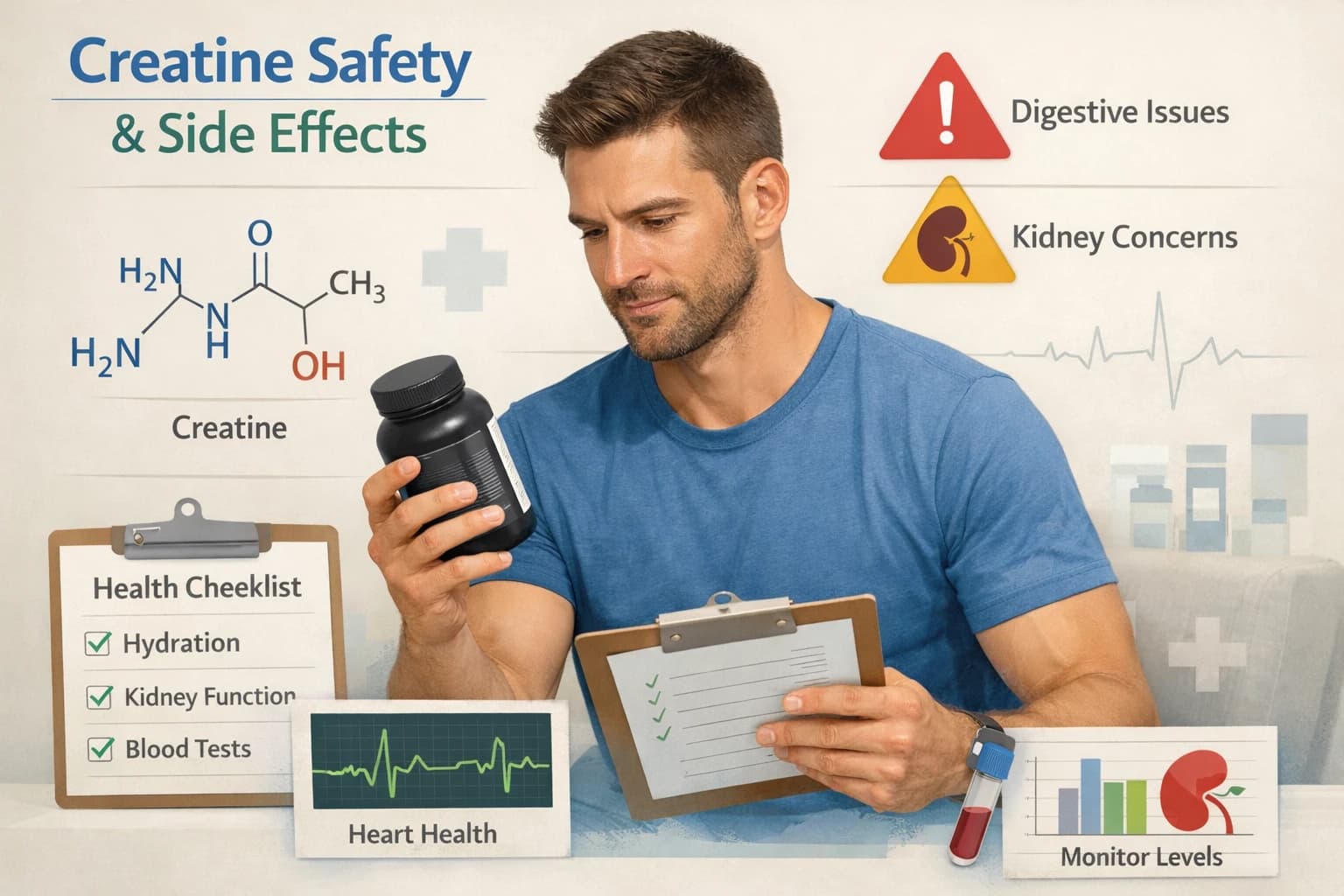
For healthy people at recommended doses, the safety record is strong. The International Society of Sports Nutrition concluded that supplementation up to 30 grams a day for as long as five years is safe and well tolerated in healthy people, from children to older adults (Kreider et al., 2017).
A few persistent myths are worth retiring. A detailed review of common questions found that, in healthy people at recommended doses, creatine does not damage the kidneys, does not cause hair loss, and does not cause dehydration or muscle cramping (Antonio et al., 2021). The main real effect is a small amount of water held inside the muscle, which can nudge the scale up a pound or two early on.
The sensible caveat: if you have existing kidney disease, are pregnant or breastfeeding, or take regular medication, check with a doctor first. We go deeper in our guide to creatine safety and side effects.
How to take it, briefly
You do not need to overthink this.
- Form: creatine monohydrate. It is the most-researched and cheapest form, and newer versions have not been shown to work better (Kreider et al., 2017).
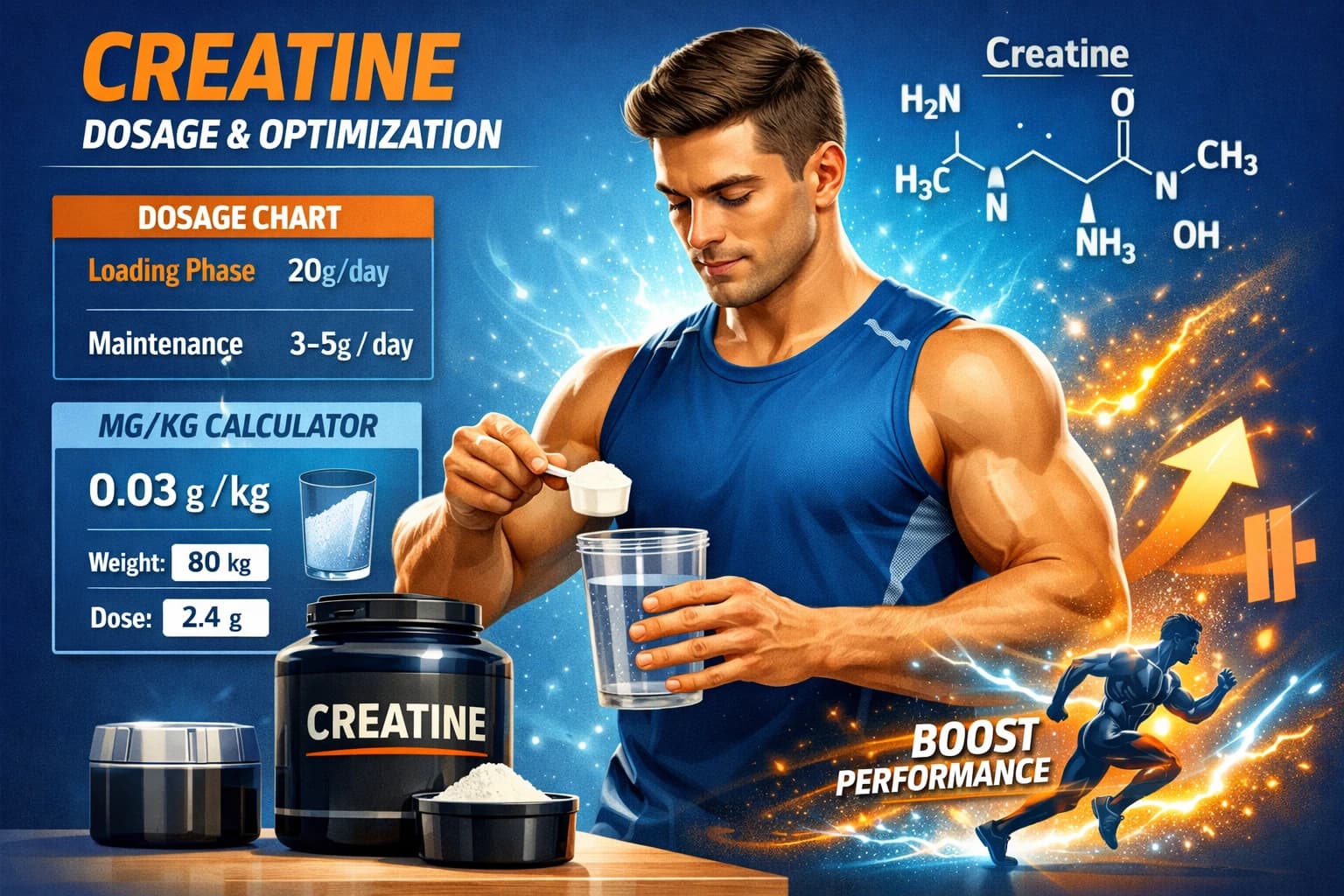
- Amount: 3 to 5 grams a day is the standard maintenance dose.
- Loading is optional. A loading phase saturates your muscles faster, but a steady daily dose reaches the same place within a few weeks. You do not have to load (Antonio et al., 2021).
- Consistency beats timing. Taking it every day matters more than the exact hour. Mixing it with water or a meal is fine.
For the full breakdown of dosing, loading, and timing, see our creatine dosage guide.
The bottom line
Creatine is effective, cheap, and, for healthy people, safe. It is not magic: it works best alongside consistent resistance training, and it will not replace the basics of food, sleep, and effort. But among supplements, it is one of the very few that lives up to the evidence. Explore our nutrition guides for how it fits into the bigger picture.
Frequently Asked Questions (FAQ)
Does creatine actually work? Yes, for what it is meant to do. Combined with resistance training, creatine reliably increases strength and power more than training alone. It is one of the few supplements with strong, repeated evidence behind it.
Is creatine a steroid? No. Creatine is a compound your body already makes from amino acids and that you get from meat and fish. It is not a hormone or a steroid.
Do I need to do a loading phase? No. Loading saturates muscle faster, but taking 3 to 5 grams a day reaches the same level within a few weeks. Loading is optional, not required.
Will creatine make me gain weight? You may see a small rise on the scale early on, mostly water held inside the muscle, not fat. Any longer-term gain comes from the extra muscle that training builds.
Does creatine damage your kidneys? In healthy people taking recommended amounts, the evidence does not show kidney damage. If you have existing kidney disease, ask your doctor before taking it.
Which form should I buy? Creatine monohydrate. It is the most-studied, cheapest form, and newer forms have not been shown to work better.
Medical disclaimer: This article is for informational purposes only. Always consult a qualified healthcare provider before making changes to your health routine.
Sources
- Kreider RB, et al. International Society of Sports Nutrition position stand: safety and efficacy of creatine supplementation in exercise, sport, and medicine. Journal of the International Society of Sports Nutrition, 2017 — PubMed. https://pubmed.ncbi.nlm.nih.gov/28615996/
- Antonio J, et al. Common questions and misconceptions about creatine supplementation: what does the scientific evidence really show? Journal of the International Society of Sports Nutrition, 2021 — PubMed Central. https://pmc.ncbi.nlm.nih.gov/articles/PMC7871530/
- Rawson ES, Volek JS. Effects of creatine supplementation and resistance training on muscle strength and weightlifting performance. Journal of Strength and Conditioning Research, 2003 — PubMed. https://pubmed.ncbi.nlm.nih.gov/14636102/
- Rae C, et al. Oral creatine monohydrate supplementation improves brain performance: a double-blind, placebo-controlled, cross-over trial. Proceedings of the Royal Society B, 2003 — PubMed. https://pubmed.ncbi.nlm.nih.gov/14561278/
- Smith-Ryan AE, et al. Creatine supplementation in women's health: a lifespan perspective. Nutrients, 2021 — PubMed Central. https://pmc.ncbi.nlm.nih.gov/articles/PMC7998865/
All sources accessed 31 May 2026.

Sophia Martinez, MS, CNS
A wellness researcher focused on what the evidence actually says.